Safety and Neighborhoods in Los Angeles: What I'd Actually Tell a Friend
Is Los Angeles safe for visitors?
Most tourist areas of Los Angeles are visited every day without incident, but the city is a huge, uneven patchwork rather than one place, so conditions vary a lot between and even within neighborhoods. Ordinary big-city precautions — watching your belongings, being alert at night away from busy areas, checking recent reviews before parking somewhere unfamiliar — go a long way.
The question I get asked before every trip here
Almost every friend who’s planned a first visit to Los Angeles has asked me some version of the same thing: is it safe? I understand why. The city has a reputation, built up over decades of movies and news coverage, that doesn’t map cleanly onto what a visitor actually experiences. My honest answer, after spending a lot of time here, is that there isn’t a single answer — because there isn’t a single Los Angeles.
This is the part that trips people up before they’ve even landed. LA isn’t a compact old-town core you can walk end to end in an afternoon, the way you might in a European city. It’s a sprawling basin of very different districts, plus a much wider region of separate beach towns, desert resorts and wine country stretched across Southern California.
Santa Monica, Beverly Hills and Pasadena are independent cities with their own governments, not neighborhoods of LA proper, even though they sit inside the same urban sprawl. That fragmentation is exactly why “is LA safe” is the wrong question. The better one is: what’s this particular street, at this particular hour, actually like?
Why I won’t rank neighborhoods for you
I want to be upfront about something I’ve decided not to do in this piece: I’m not going to give you a tidy list of “safe” and “dangerous” neighborhoods. Partly that’s because conditions genuinely change block by block — a street can feel completely different a few hundred meters from a major attraction. Partly it’s because conditions change over time, and a label I write today could be stale within a year. And partly it’s because a flat ranking gives false confidence in one direction and unfair stigma in the other. No area of a metropolis this size is guaranteed trouble-free, and no area is entirely without incident.
What I do instead, every time I’m heading somewhere I don’t know well — whether that’s a stretch of Downtown LA, a quiet pocket near Venice Beach, or a side street I’m parking on near Griffith Observatory — is spend two minutes checking recent reviews, recent local news, or simply asking my hotel or a local. That habit tells me far more, and far more current information, than any general reputation the area might have.
The precautions that actually matter
None of what follows is specific to LA. It’s the same baseline awareness I’d bring to any large city, but it’s worth repeating because visitors relax it on vacation more than they would at home.
- Keep valuables out of sight, always. Car break-ins are a real and widely reported issue across the region — at trailhead parking, beach lots and street parking near popular sights alike. I never leave a bag, a phone, or even a charging cable visible on a seat; everything goes in the trunk, ideally packed before I arrive rather than moved in view of anyone nearby.
- Be more alert after dark in quiet stretches. Busy corridors like the Santa Monica pier area or central Hollywood Boulevard have plenty of foot traffic well into the evening. Step a few blocks off the main strip, though, and the picture changes fast — fewer people, less light, less predictability. I stick to well-lit main streets at night and, where I can, travel with someone else.
- Check before you park somewhere unfamiliar. A quick search of an address or a glance at recent local reviews takes thirty seconds and tells you far more than guesswork. This matters as much near a trailhead in the San Gabriel foothills as it does on a Downtown side street.
- Keep an eye on your belongings in crowds. Busy tourist spots — the Hollywood Sign viewpoints, Universal Studios Hollywood, the Getty Center grounds, Disneyland — draw large crowds, and large crowds are where petty theft happens, in any city on earth. A bag zipped and worn in front of you is a small habit that removes most of the risk.
- Stay weather- and season-aware, not just street-aware. Southern California’s minor earthquakes are a routine, largely unnoticeable part of daily life here and shouldn’t worry a typical visitor. Autumn’s dry, wind-driven Santa Ana conditions do raise wildfire risk, particularly inland and in the hills, so if you’re planning to hike near Joshua Tree or the mountains in that season, a quick check of local alerts is sensible.
How I actually plan around this
In practice, safety awareness shapes my itinerary less than people expect. I still spend full days in West Hollywood, wander Melrose, and take an evening walk along the Venice Beach boardwalk. What changes is how deliberately I move between areas: I plan routes toward known, busy destinations rather than drifting block by block with no destination in mind, and I lean a little more on rideshare or a car after dark instead of a long unplanned walk.
One thing that’s genuinely reassuring, and worth remembering when the sprawl starts to feel disorienting, is that a guided outing takes the navigation and the unfamiliar-street judgment calls off your plate entirely for a few hours. A guided hike up to the Hollywood Sign viewpoints or a guided highlights tour of the city puts someone who knows the current lay of the land in charge of the route, which is one less thing to think about on a first visit.
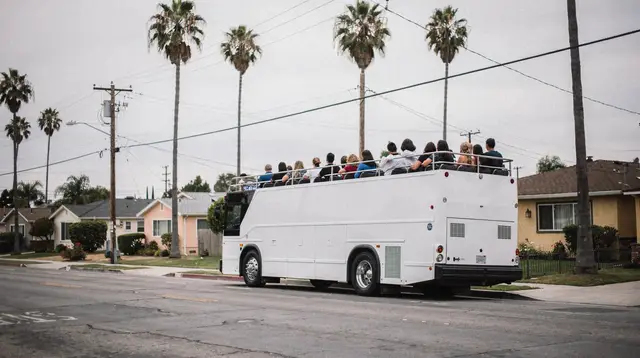
For a wider first look at how the districts relate to each other, an open-air bus tour through Hollywood and Beverly Hills is a low-effort way to get oriented before you start exploring on foot, and if you’d rather see how the whole sprawl fits together from above, a helicopter tour over the city’s landmarks makes the fragmented geography click in a way street-level walking never quite does.
The honest bottom line
I don’t think Los Angeles is a uniquely risky place to visit, and I don’t think it’s a place where you can switch off your judgment either. It’s a normal, very large American city, and the same rules that keep you comfortable in any big city — watch your things, read the room after dark, check before you commit to an unfamiliar street — apply here just as they would in Downtown LA, in Long Beach, or out toward Pasadena.
No neighborhood I’ve mentioned here is guaranteed trouble-free, and none deserves a blanket warning either. Treat the sprawl for what it is — dozens of distinct places stitched into one metro area — and plan block by block, not by reputation.
Tours to help plan your Los Angeles trip
Verified deep-linked GetYourGuide tours. Book through these links and we earn a small commission at no cost to you.
GetYourGuide does not provide a product photo for this activity — the image shows the meeting point, photographed by us.