The district that invented the idea of Hollywood
Long before it was a neighborhood people actually visited, Hollywood was an idea — a byword for the movie business itself, built on a patch of Los Angeles that studios colonized in the early twentieth century because the light was reliable and the land was cheap. That history is still the reason to come here.
Walking Hollywood Boulevard or standing below the hills where the sign sits is, for most visitors, less about ticking off a sight and more about standing inside a myth that has been exported to the rest of the world for a hundred years. It is worth being clear from the outset about what that myth delivers and what it does not, because Hollywood today is a dense, sometimes gritty urban district, not a theme park built around its own legend.
It helps to separate Hollywood clearly from its neighbors before going further. Beverly Hills, just to the southwest, is residential and retail — mansions, Rodeo Drive, old money rather than old film sets. West Hollywood, bordering Hollywood on its western edge, is built around nightlife, design showrooms and the Sunset Strip, a livelier and more contemporary scene.
Hollywood itself is the historic core: the studios that built the industry, the boulevard that celebrated its stars, and the hills that still carry its most photographed symbol. Treat the three as separate destinations with separate purposes rather than one continuous strip, and a Los Angeles itinerary reads much more clearly.
The Hollywood Sign: what it actually is, and is not
The single most common misunderstanding about Hollywood concerns the sign itself. There is no public path, road or gate that leads to the letters, and no legitimate way to walk up and touch them. The sign sits on Mount Lee, on land managed to keep visitors at a distance, both because the hillside is fragile and because the site has no visitor infrastructure — no parking, no facilities, nothing built to receive foot traffic at its base. Anyone planning a trip around getting close to the letters should recalibrate that plan now, before arriving with the wrong expectations.
What does work, and works well, is viewing the sign from a distance. Griffith Observatory, a short drive above the Los Feliz and Los Angeles neighborhoods, is the single most popular vantage point: its terraces face the sign directly, the building itself is a striking piece of 1930s architecture, and the view extends across the LA basin on a clear day.
Lake Hollywood Park, tucked into a residential pocket north of the boulevard, offers a quieter and arguably more classic framing — the letters rising cleanly above the reservoir and the hills, with far fewer crowds than the Observatory draws at sunset. Beyond those two fixed points, a network of hiking trails through Griffith Park brings walkers to various ridge lines with their own angles on the sign, ranging from easy paved loops to steeper unpaved climbs.
A guided option removes the guesswork of finding parking and timing a viewpoint correctly: a guided hike up to one of the best sign viewpoints handles the routing and the context, which matters given how limited and contested parking near Griffith Park’s best spots can get, especially at sunset and on weekends. Travelers based closer to the coast sometimes prefer to combine the sign with a beach morning; a tour that pairs Santa Monica Pier with a Hollywood Sign viewpoint is built around exactly that pairing, useful for anyone staying near the water rather than in central Hollywood.
Hollywood Boulevard and the walk of fame
Hollywood Boulevard is where the industry’s self-mythology becomes physically walkable. The Walk of Fame’s brass stars run for blocks along the sidewalk, the forecourt of the TCL Chinese Theatre still displays the hand and footprints of decades of stars, and the Dolby Theatre — home to the Academy Awards in most recent years — anchors the Hollywood & Highland complex a short walk away. The El Capitan Theatre, restored to something close to its 1920s condition, remains an active cinema rather than a museum piece, which is a useful reminder that Hollywood is not entirely frozen in amber: parts of it still function as the industry they commemorate.
It is fair to say the boulevard itself divides opinion. Alongside genuine landmarks sit wax museums, costumed street performers working for tips, and a fair amount of souvenir-shop clutter — the boulevard has never fully shaken a reputation for feeling more commercial than cinematic up close. Visitors who arrive expecting a polished, purely nostalgic experience are sometimes disappointed; those who arrive expecting a dense, slightly chaotic urban strip with real landmarks embedded in it tend to enjoy it more. A short, focused visit — an hour or two around the Chinese Theatre forecourt and a stretch of the stars — generally works better than trying to absorb the entire boulevard end to end.
Studios, backlots and where Universal actually sits
Hollywood’s studio history runs deep, but it is worth separating two very different kinds of “studio experience” before booking anything. A working-studio tour visits an active film and television lot — soundstages, backlots and sets that may be in production use on the day of the visit — and is built around access and insight rather than rides. A theme-park-style studio experience, by contrast, is built around attractions, shows and rides themed to franchises, with production use a much smaller part of the pitch. These are genuinely different products, and comparing prices or expectations across the two leads to disappointment either way.
This distinction matters most because of a location mix-up that trips up a large share of first-time visitors: Universal Studios Hollywood is not in the Hollywood district. It sits in Universal City, a separate area a short drive north, adjoining Hollywood but administratively and geographically distinct from the boulevard and the historic studio core covered on this page.
It should also never be confused with Disneyland, which is a wholly separate resort roughly an hour away in Anaheim, Orange County — different owner, different state-side counterpart (Walt Disney World, in Florida), different park entirely. Anyone planning a single Los Angeles day around “the studios” should decide first whether they want historic Hollywood, working-lot access, or the Universal City theme park, because a single day rarely accommodates more than one of the three comfortably.
Practical logistics: getting there and around
Hollywood is best reached and explored by car, like most of Los Angeles, though it is one of the better-served districts for LA Metro: the Metro B (Red) Line runs directly beneath the boulevard with stops at Hollywood/Highland and Hollywood/Vine, making a car-free morning realistic for the boulevard itself. Reaching the sign’s viewpoints, however, is a different matter — Griffith Observatory and Lake Hollywood Park are not well served by transit, and a car, taxi or rideshare is effectively required to reach either one without a long uphill walk.
Traffic shapes the practical side of any Hollywood day. Trips into and out of the district — to Downtown LA, to the beaches, to Beverly Hills — generally run 20 to 40 minutes off-peak, but can stretch well past an hour during the weekday morning and evening rush. Parking near the boulevard’s busiest blocks is metered and can be tight; paid lots near the Hollywood & Highland complex are usually the more reliable option than street parking on a weekend afternoon.
| Route from Hollywood | Off-peak drive | Rush hour |
|---|---|---|
| To Downtown LA | ~20 minutes | 35-45+ minutes |
| To Beverly Hills | ~20 minutes | 30-40 minutes |
| To Santa Monica | ~30-35 minutes | 50-70+ minutes |
| To Griffith Observatory | ~15-20 minutes | 20-30 minutes |
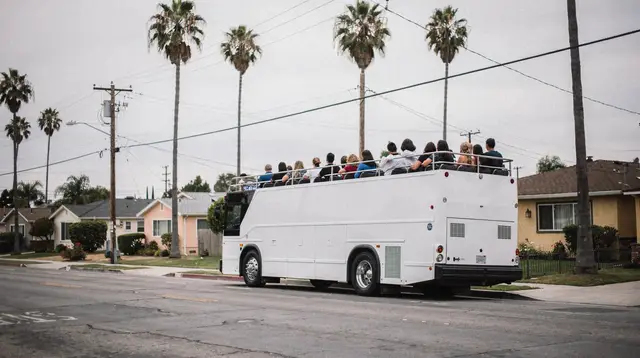
For visitors who would rather not navigate Hollywood, Beverly Hills and the Sunset Strip separately by car, an open-air bus tour covering Hollywood and Beverly Hills strings the districts together in a single guided loop, which is a reasonable way to get oriented on a first visit before deciding where to spend a return trip’s time. A broader guided city highlights tour goes further afield, folding Hollywood into a wider Los Angeles overview for visitors with only a day or two in the city.
Where Hollywood fits in a wider Los Angeles trip
Hollywood works best as a focused half-day or full day rather than a home base for an entire trip. Its hotel stock and restaurant scene are real but uneven, and travelers who prioritize beach access or a quieter evening often base themselves in Santa Monica or West Hollywood instead, visiting Hollywood as a day trip.
For a first Los Angeles visit, pairing Hollywood with Griffith Park and Griffith Observatory into a single day is a natural fit, since the observatory’s sign viewpoint and its own exhibits sit only a short drive from the boulevard; the one-day Hollywood and Griffith itinerary lays out that pairing in more detail. Visitors curious about how film-industry glamour shows up elsewhere in the region — celebrity real estate rather than celebrity history — can also look at Beverly Hills’s celebrity homes tours as a related but distinct thread.
Downtown LA, by contrast, is a different kind of urban core entirely — civic buildings, the Arts District, Union Station — and should not be assumed to be within easy walking distance of Hollywood; the two are connected by Metro rail but are genuinely separate districts with separate characters. It is also worth remembering, while planning any of this, that Los Angeles is not California’s capital; that distinction belongs to Sacramento, several hours north.
Hollywood, seasons and crowds
Hollywood’s crowd patterns track its two main draws differently. The boulevard is busy nearly year-round, with the heaviest foot traffic on weekend afternoons and evenings; a weekday morning visit avoids much of the congestion around the Chinese Theatre forecourt. The sign viewpoints have their own rhythm: Griffith Observatory’s grounds and parking fill fastest around sunset, when the light on the skyline and the sign is at its best and every other visitor has had the same idea. Arriving an hour or more before sunset, or alternatively well after the evening rush has passed, generally makes for an easier visit.
Spring and autumn bring the most reliable combination of clear skies and comfortable hiking temperatures for the Griffith Park trails. Coastal LA’s late-spring “June Gloom” marine layer can dull views from the hills on overcast mornings, so afternoons are often a safer bet for sign photography in May and June specifically. Summer heat makes the steeper, unshaded trail routes to the sign’s ridge lines considerably more demanding, and the Santa Ana wind season in autumn can occasionally bring temporary trail closures tied to fire risk — worth checking current conditions before committing to a longer hike.
Booking ahead and setting expectations
Nothing covered in this guide requires booking weeks out, but the more popular guided options around the sign and the boulevard do fill their preferred time slots, particularly weekend sunset departures for sign viewpoint hikes. Booking a day or two ahead is a reasonable habit rather than a strict requirement. As with the rest of Los Angeles, prices are not shown with sales tax included, and a tip is customary on restaurant and bar bills around the boulevard — the final total will run noticeably higher than the number on the menu.
Hollywood FAQ: sign visits, studios and boulevard logistics
Can I hike all the way up to the Hollywood Sign?
No. There is no public trail or access point that reaches the letters themselves, and the immediate area around the sign is fenced and monitored. Trails in Griffith Park bring hikers to nearby ridges with clear views of the sign from a respectful distance, which is as close as a visit legitimately gets.
What is the best viewpoint for photographing the Hollywood Sign?
Griffith Observatory offers the most famous and most convenient view, with a large terrace and parking (though it fills up, especially at sunset). Lake Hollywood Park gives a quieter, more classic straight-on framing with the reservoir in the foreground and considerably smaller crowds.
Is Universal Studios Hollywood located in the Hollywood district?
No. Universal Studios Hollywood sits in Universal City, a separate area adjoining Hollywood, not within the district covered by Hollywood Boulevard and the historic studio core. It is also a different resort entirely from Disneyland, which is in Anaheim.
How much time should I plan for Hollywood?
A half day covers the boulevard’s key landmarks comfortably; a full day allows time to add a Griffith Observatory or Griffith Park sign viewpoint without rushing either stop.
Do I need a car to visit Hollywood?
Not strictly for the boulevard itself, which the Metro B (Red) Line serves directly. Reaching Griffith Observatory or Lake Hollywood Park without a car is much harder, since neither is well served by transit — a car, taxi or rideshare is the practical option.
Is Hollywood Boulevard worth visiting, or is it too touristy?
It is genuinely touristy in stretches, with costumed performers and souvenir shops alongside real landmarks like the TCL Chinese Theatre forecourt. A short, targeted visit tends to work better than expecting a purely nostalgic experience across the whole boulevard.
What is the difference between a studio tour and Universal Studios Hollywood?
A working-studio tour visits an active production lot’s soundstages and backlots, focused on access and insight. Universal Studios Hollywood is a theme park built around rides and shows themed to franchises, located in Universal City rather than Hollywood itself.
When is the best time of year to visit Hollywood?
Spring and autumn generally offer the clearest skies and most comfortable temperatures for both the boulevard and any hike toward a sign viewpoint. Summer heat makes the unshaded trail routes more demanding, and early-summer coastal cloud cover can dull hillside views on some mornings.