Hollywood Boulevard and the Walk of Fame: A Practical Guide
What can you actually do on Hollywood Boulevard?
Hollywood Boulevard is a walkable strip in the Hollywood district of Los Angeles where visitors follow the Walk of Fame's terrazzo stars, see the Dolby Theatre and TCL Chinese Theatre forecourt, and join guided or self-guided tours, photo stops and evening outings. It does not offer access to the Hollywood Sign itself, which is viewed from separate vantage points elsewhere in the area.
What Hollywood Boulevard actually is
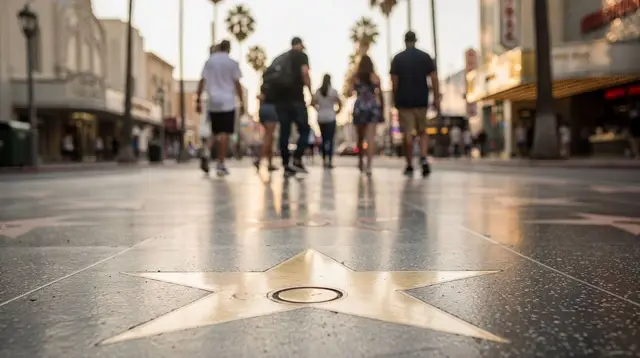
Hollywood Boulevard is the main commercial strip running through the Hollywood district of Los Angeles, lined with the terrazzo stars of the Walk of Fame, the forecourt of the TCL Chinese Theatre, the Dolby Theatre, and a dense run of souvenir shops, tour operators and street performers dressed as film characters. For a first-time visitor arriving from elsewhere in the metropolitan area, it is worth being clear from the outset about what this stretch of pavement offers and what it does not: it is a walkable, photogenic entertainment district, not a route to the Hollywood Sign, and not a venue where meeting a working actor is part of the experience.
Hollywood itself is a neighbourhood inside the city limits of Los Angeles, distinct from independent cities nearby such as Beverly Hills and West Hollywood, which sit close by but are governed separately. Confusing the three is a common mistake, since all three appear in the same general area on a map and share a broadly similar entertainment-industry identity.
Getting to Hollywood Boulevard
Once you are standing on the boulevard, everything worth seeing is within a few blocks and easily covered on foot. The harder part is the journey there. If you are staying in Downtown LA, the drive or train ride typically runs 20 to 30 minutes outside peak hours, longer during the morning and evening rush. From the Westside or the beach cities, expect 30 to 60 minutes or more by car depending on the time of day, since the same route can take roughly twice as long at rush hour as it does in free-flowing traffic. LA Metro’s rail line serves Hollywood directly, which makes it one of the easier destinations in the region to reach without a rental car, particularly compared with the Getty Center or the desert.
Parking on or immediately around the boulevard is metered and can be tight on weekends and evenings; several parking structures serve the main tourist blocks at an hourly or flat evening rate. Arriving by rail or rideshare avoids the parking search entirely, which is a real advantage here even for visitors who are renting a car for the rest of their trip.
The Walk of Fame
The Walk of Fame consists of more than 2,700 brass-and-terrazzo stars embedded in the sidewalk along Hollywood Boulevard and a section of Vine Street, each honouring a figure from film, television, music, radio or theatre. New stars are added throughout the year, so the walk is a living, growing installation rather than a fixed historical display. Walking the full stretch at a browsing pace, stopping to photograph favourite names, takes most visitors one to two hours.
The stars are unticketed and free to view at any time of day, which makes the Walk of Fame one of the few genuinely no-cost activities in central Los Angeles. The trade-off is crowding: the busiest blocks, particularly around the TCL Chinese Theatre, can be dense with visitors, street performers and vendors, especially on weekend afternoons and evenings.
The Dolby Theatre and the TCL Chinese Theatre
The Dolby Theatre, home to the Academy Awards ceremony, sits directly on the boulevard and offers guided interior tours on select days when the venue is not in use for an event, rehearsal or private function. Because scheduling varies, checking availability before planning a visit around a tour is worth the few minutes it takes, rather than assuming a walk-up ticket will be available.
Next door, the forecourt of the TCL Chinese Theatre (long associated with celebrity handprints and footprints set in cement) is free to walk through and photograph, and remains one of the most reliably crowded single spots on the boulevard. The theatre itself continues to operate as a working cinema, with screenings that require a separate paid ticket like any other film showing.
A boundary worth stating plainly: the Hollywood Sign
The Hollywood Sign is not on Hollywood Boulevard, and it cannot be reached on foot, by car up to its base, or by any public access route from the boulevard itself. There is no ticketed entry, no path that leads a general visitor directly to the letters, and no legitimate tour product that delivers a close-up visit to the sign. Content and tour listings that suggest otherwise are describing distant viewpoints, not physical access.
The recognised ways to see the sign are all separate from Hollywood Boulevard: Griffith Observatory offers a well-known distant view along with its own free exhibits, Lake Hollywood Park provides a popular photo angle from below, and several marked hiking trails through Griffith Park bring walkers progressively closer at a distance, without ever reaching the sign’s base.
Anyone planning to combine a boulevard visit with a sign viewpoint should treat these as a separate stop entirely, usually requiring its own drive or rideshare, not a short walk from the Walk of Fame. For a fuller comparison of viewpoints and trail options, a dedicated guide covers the Hollywood Sign and Griffith Park pairing on its own terms.
Guided tours and structured activities
For visitors who want context rather than a self-guided wander, a walking tour of the Walk of Fame adds historical background on the stars, the theatres and the boulevard’s studio-era origins that is easy to miss reading plaques alone.
a guided walk along the Walk of Fame covering its landmark stars and theatre historyHollywood Boulevard also has a well-established evening identity, distinct from its daytime tourist crowd. Once the sidewalks thin out from daytime sightseeing but the shopfronts and theatres stay lit, themed night outings become a popular alternative to another daytime lap of the same stars.
an evening pub crawl that threads through bars along the Walk of Fame with a haunted-history angleVisitors who want to see Hollywood Boulevard as one stop among several rather than a standalone destination often combine it with a wider open-air bus route through the surrounding districts, useful for getting a sense of scale across a sprawling city where distances are rarely obvious on foot.
an open-air bus route linking Hollywood Boulevard with Beverly Hills and nearby districtsNearby districts worth pairing with a boulevard visit
Because Hollywood is one neighbourhood among many rather than a self-contained day out, most visitors pair it with something else nearby rather than treating it as an all-day plan on its own. Griffith Observatory and the surrounding park make a natural half-day addition for anyone chasing Hollywood Sign views, while a short drive brings you into West Hollywood and the Sunset Strip for a different, less souvenir-shop-heavy evening scene.
Beverly Hills and its retail streets sit a short drive further west, and Downtown LA offers a contrasting mix of museums, markets and architecture for a second half of the day.
A structured one-day itinerary built around Hollywood and Griffith Park is one practical way to sequence these without doubling back across the city, and a two-day first-timer’s itinerary works well if this is your only visit to the Los Angeles area on this trip.
What Hollywood Boulevard is not
It is worth being direct about the gap between the boulevard’s image and its reality, since managing expectations here avoids a common source of disappointment. Hollywood Boulevard is not a working film set, and walking it does not put you near an active production; studio tours of real soundstages and backlots are a separate, ticketed product located elsewhere in the city, distinct from the boulevard’s shops and theatres. It is also not a reliable place to encounter working actors or celebrities; the costumed street performers posing for photos are a paid, unaffiliated tourist trade, not a substitute for a genuine sighting, and no tour or ticket on the boulevard promises one.
Finally, Hollywood Boulevard is not the Hollywood Sign, is not within walking distance of it, and no legitimate activity based on the boulevard delivers physical access to it. Treating the two as one destination is the single most common planning error visitors make before arriving.
Practical notes for a visit
| Consideration | What to expect |
|---|---|
| Typical time needed | 2-4 hours for the Walk of Fame and theatre forecourts; half a day with a guided tour or evening activity |
| Cost to view the stars | Free; theatre tours and evening activities are separately ticketed |
| Best way to arrive | LA Metro rail, rideshare, or a parking structure on/near the boulevard |
| Crowds | Heaviest on weekend afternoons and evenings, especially near the TCL Chinese Theatre forecourt |
| Hollywood Sign access | Not available from the boulevard; see Griffith Observatory, Lake Hollywood Park or Griffith Park trails separately |
| Evening character | Well lit, busy with shops, bars and themed tours; a different atmosphere from the daytime tourist crush |
A guided city overview is a reasonable option for visitors who want Hollywood Boulevard folded into a broader half-day or full-day sweep of Los Angeles landmarks rather than a standalone stop.
a guided city tour that includes Hollywood Boulevard among wider Los Angeles highlightsHollywood Boulevard, the Walk of Fame and Dolby Theatre in context
Seen against the wider things to do in Hollywood and the broader category of Hollywood Boulevard activities, the boulevard works best as a focused, walkable stop rather than a full-day plan.
It rewards visitors who arrive with realistic expectations: a genuinely free, endlessly photographable stretch of film history underfoot, a working theatre with its own tour schedule, and an evening scene that holds up once the daytime crowds thin. What it does not offer is proximity to the Hollywood Sign or any promise of a celebrity encounter, and building those two expectations into a plan is the most common way visitors set themselves up for disappointment on an otherwise straightforward stop.
For background on the district’s other well-known draw, a companion piece on celebrity homes in the wider Los Angeles area covers a related but separate activity, useful for visitors who want to extend a Hollywood-themed day beyond the boulevard itself. Those planning a first visit more broadly may also find it useful to check how Hollywood Boulevard fits into a full first-timer’s schedule for the city before locking in a single day’s plan around it.
FAQ: Hollywood Boulevard and the Walk of Fame
Can I walk from Hollywood Boulevard to the Hollywood Sign?
No. The Hollywood Sign sits high in the hills above the boulevard and there is no pedestrian route from Hollywood Boulevard up to its base for casual visitors. It is viewed and photographed from designated points in Griffith Park, Lake Hollywood Park or from a distance around Hollywood itself, not reached on foot from the boulevard.
Where is the best place to see the Hollywood Sign up close?
There is no official up-close public access point at the sign. Griffith Observatory, Lake Hollywood Park and several marked hiking trails in Griffith Park are the recognised viewpoints, each offering a different distance and angle rather than a close approach to the letters themselves.
How long do you need for Hollywood Boulevard and the Walk of Fame?
Most visitors spend two to four hours walking the Walk of Fame, seeing the Dolby Theatre exterior and the TCL Chinese Theatre forecourt, and browsing nearby shops. Adding a guided tour, a themed evening activity or a sit-down meal can extend a visit to half a day.
Will I meet celebrities on Hollywood Boulevard?
Not reliably. Hollywood Boulevard is a busy tourist and entertainment strip, not a place where celebrity sightings are expected or guaranteed, despite the costumed street performers and the star-studded pavement underfoot.
Is Hollywood Boulevard walkable, or do I need a car?
Once you are on the boulevard, it is entirely walkable, with the main sights concentrated over a few blocks. Getting to Hollywood from other parts of the Los Angeles area, however, is a separate matter and can take anywhere from 20 minutes to well over an hour depending on traffic and starting point.
Can you tour the Dolby Theatre?
The Dolby Theatre offers guided tours on select days when no event or rehearsal is scheduled, covering the auditorium and Academy Awards history. Availability varies day to day, so checking ahead rather than assuming walk-up access is the safer approach.
Is Hollywood Boulevard safe at night?
The boulevard stays busy and well lit into the evening, with plenty of foot traffic, shops and restaurants open late, which is part of why themed night tours and pub crawls operate there. As with any dense urban strip, standard city-visitor caution around belongings and surroundings still applies.
Hollywood Boulevard
Verified deep-linked GetYourGuide tours. Book through these links and we earn a small commission at no cost to you.
GetYourGuide does not provide a product photo for this activity — the image shows the meeting point, photographed by us.