The vertical core of a horizontal city
Los Angeles is famous for sprawling outward, but Downtown LA (often shortened to DTLA) is where it finally goes up. This is the one skyline most visitors associate with a “big American city”: glass office towers, a cluster of high-rise hotels, courthouses and government buildings, and a growing residential population living in converted lofts.
Where Hollywood trades on film and TV history and Beverly Hills trades on residential glamour, Downtown LA is something different: the administrative, financial and increasingly cultural centre of the metropolitan region, built around office towers, courtrooms, concert halls and a working transit hub rather than studio lots or celebrity streets.
That distinction matters for how to plan a visit here. Downtown LA is not a nightlife-and-sightseeing district built for tourists first; it is a functioning business district that happens to have museums, a historic core, food markets and a growing arts scene layered on top of daytime office life. Weekdays feel different from weekends — busier with commuters at lunchtime, quieter in the evenings in some pockets, livelier in others around the Arts District and LA Live. Visitors who come expecting a European-style old town, walkable end to end with cafés spilling onto every corner, will find something closer to a genuine, sometimes gritty, working city centre with excellent pockets, not a uniformly polished tourist zone.
Metro access: the exception, not the rule
If there is one practical fact that sets Downtown LA apart from most of the rest of the region, it is transit. Downtown is one of the few parts of Los Angeles genuinely well served by LA Metro’s rail network. Union Station, the city’s grand 1930s transportation hub, anchors several rail lines and connects onward to Pasadena, Hollywood, and out toward Santa Monica on the light-rail network, alongside regional and long-distance trains. Within Downtown itself, several rail stations sit close enough together that a visitor can reasonably move between the Arts District, the Historic Core, Bunker Hill and LA Live without a car.
That is a meaningful exception in a city where a rental car is usually the practical default. It does not, however, extend very far. Once a visitor wants to reach Hollywood’s studios, the Getty Center, Malibu’s coastline or the desert, the same car-dependent reality that applies everywhere else in Los Angeles reasserts itself. Downtown’s Metro advantage is real, but it is local — useful for a day or two spent in and immediately around the district, not a substitute for a wider itinerary plan.
Office life, culture and the Downtown skyline
Downtown LA’s daytime identity is shaped by the people who work here: lawyers, civil servants, finance and media professionals filling towers that rise well above anything in Hollywood or on the Westside. That office-district character is not incidental — it is what gives Downtown its particular rhythm, its lunch spots, its weekday energy, and its relative quiet on some evenings and weekends in certain blocks even as others (LA Live, the Arts District) stay lively after dark.
Layered onto that administrative core is a cultural district that has grown substantially over the past two decades. The Broad and the Museum of Contemporary Art sit near Walt Disney Concert Hall’s stainless-steel curves on Bunker Hill. Grand Central Market, a covered food hall dating to 1917, draws both office workers on lunch break and visitors working through its stalls. The Arts District, a former warehouse zone east of the Historic Core, has become a hub for galleries, breweries and design-forward restaurants.
Little Tokyo preserves one of the country’s most significant Japanese-American cultural districts. This mix of civic weight and cultural density is what separates Downtown from the entertainment-industry focus of Hollywood and the residential exclusivity of Beverly Hills — it is where the city administers and increasingly where it exhibits itself, rather than where it performs for cameras.
A guided overview is a practical way to get oriented quickly across a district this layered. A city highlights tour with a guide, such as the Los Angeles: City Highlights Tour with Guide, typically threads together Downtown’s civic and cultural landmarks alongside stops further afield, which helps make sense of how the district fits into the wider region on a first visit.
Koreatown, right next door
Immediately west of the Historic Core and Bunker Hill sits Koreatown, one of the densest and most distinct neighbourhoods in the entire city. It is technically a separate district, not part of Downtown proper, but the two sit close enough — a short Metro ride or a manageable drive — that they are often treated as a single outing.
Koreatown’s identity is built on round-the-clock Korean barbecue restaurants, karaoke rooms, spas and a genuinely 24-hour street energy that contrasts with Downtown’s more office-driven daytime rhythm. For visitors staying in Downtown, an evening in Koreatown is one of the most natural short excursions available without a long drive, and it rounds out a picture of the area that goes well beyond government buildings and office towers.
What Downtown LA is not
It is worth being direct about what a Downtown LA visit does not deliver, because expectations set by other American or European city centres do not transfer cleanly here.
Downtown is not a full substitute for a walkable, dense old-town experience the way a European city centre would be. Its walkable core — roughly the Historic Core, Bunker Hill, the Arts District and Little Tokyo — is real and worth exploring on foot, but it is a cluster of pockets connected by streets that are not always pedestrian-friendly, rather than one continuously walkable centre. Some blocks between those pockets are underwhelming for a stroll, and a few areas warrant normal city awareness, particularly after dark. Treat Downtown as several walkable islands linked by a short rail ride or drive, not as a single strollable district.
Downtown also has no direct beach access. This surprises visitors who see it sitting reasonably close to the coast on a map. In practice, reaching Santa Monica, Venice Beach or Malibu from Downtown is a drive of roughly 40 minutes to well over an hour depending on the route and time of day — this is not a quick add-on to a Downtown day. The same caution applies to Hollywood, Beverly Hills and Pasadena: each looks close on a map, and each is realistically a separate 30-60 minute outing once traffic is factored in, not a stop to squeeze into the same afternoon as a Downtown walk.
Parking and weekday traffic are also worth planning around rather than ignoring. Downtown’s streets fill with commuter traffic on weekday mornings and afternoons, and on-street and garage parking near the busiest attractions and event venues can be harder to find and slower to access at peak times. None of this is unusual for a major American downtown, but it is different from the free-flowing experience visitors sometimes expect once they leave the freeway network behind.
When to visit, and how long to stay
Downtown LA follows the same broad seasonal pattern as the rest of the Los Angeles basin: dry, sunny summers are the most reliable stretch for comfortable outdoor walking between the Arts District, Bunker Hill and Little Tokyo. Spring can bring overcast mornings along the coast — the marine-layer effect known locally as May Gray and June Gloom — but this is considerably less pronounced Downtown than it is right on the beach in Santa Monica, since Downtown sits inland from the immediate coastal fog belt. Autumn brings dry Santa Ana wind conditions on occasion, more of a factor for the surrounding hills and deserts than for a day spent among Downtown’s towers, but still worth checking before a trip.
One to two days is generally enough to cover Downtown’s main pockets at a comfortable pace: a morning around Bunker Hill’s museums and Disney Concert Hall, lunch at Grand Central Market, an afternoon in the Arts District or Little Tokyo, and an evening extension into Koreatown if energy allows. Visitors building a longer LA itinerary often treat Downtown as one component alongside Hollywood, the beaches and the Westside rather than a standalone destination, which matches how the Two Days: First-Time Los Angeles and One Day: Downtown LA and Koreatown itineraries structure things.
For museum-heavy days, popular exhibitions and ticketed cultural venues around Bunker Hill can sell out or reach capacity, so booking ahead for anything time-sensitive is worth doing rather than relying on walk-up availability, particularly on weekends.
Getting to Downtown from the rest of the region
Because Downtown sits at a genuine transit hub, it is one of the easier districts to reach without a rental car — assuming a visitor is arriving from another Metro-connected area or flying into an airport with a reasonable transfer. From Hollywood, the Metro rail connection or a car ride typically runs 20 to 40 minutes depending on the time of day. From Pasadena, a direct rail line makes the trip straightforward. From the coast — Santa Monica or Venice Beach — the trip stretches to 40 minutes or considerably more by car, and while a light-rail connection exists, it is a longer ride than the Downtown-to-Hollywood hop.
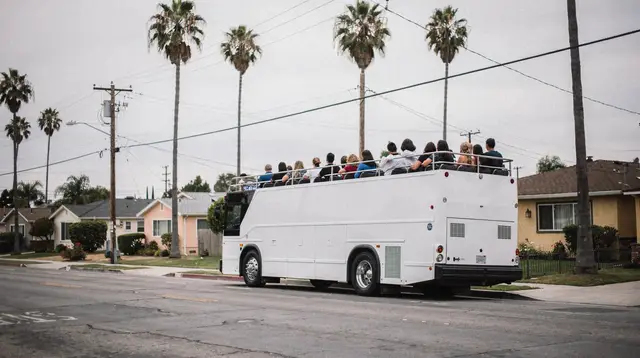
Visitors staying elsewhere and considering a single Downtown day should build in buffer time for both directions, especially if the plan involves returning during the evening commute window. A broader open-air overview tour, such as the Los Angeles: Hollywood and Beverly Hills Open Air Bus Tour, can be a useful way to see how Downtown relates geographically to West Hollywood and Beverly Hills without having to manage the driving or parking directly.
Pairing Downtown with the rest of the city
Because no single district covers everything travellers want from an LA trip, most itineraries pair Downtown with at least one other area. A common combination sets aside a day for Downtown’s civic and cultural core, then a separate day for Griffith Observatory and the Hollywood Sign viewpoints, which sit close enough to each other but still require their own dedicated block of time. An insider-style small-group visit, like the LA Griffith Observatory Insider Tour, is a practical way to handle that second day without worrying about the observatory’s notoriously limited parking.
A more compact way to sample Downtown’s own highlights without over-planning is a dedicated district tour, such as the Los Angeles: Downtown Tour, which typically covers the Historic Core, Bunker Hill and the Arts District in a guided half-day — a useful anchor for a first visit, leaving the rest of the day free for Grand Central Market or a Koreatown dinner.
For readers still deciding where to base an LA trip, the comparison in Downtown LA vs Hollywood: Where to Stay lays out the trade-offs directly, and Does the LA Metro Cover Enough of the City? and Do You Need to Rent a Car in Los Angeles? both address the transit question this guide raises about Downtown’s Metro advantage versus the rest of the region.
A wider list of things to do in the district is collected on the Downtown LA activities hub, and the Los Angeles Museums and Landmarks guide goes deeper on Bunker Hill’s cultural institutions specifically.
Downtown LA at a glance
| Feature | Downtown LA | Hollywood | Beverly Hills |
|---|---|---|---|
| Main identity | Business, civic, cultural core | Film and TV tourism | Residential luxury |
| Metro access | Strong (Union Station hub) | Moderate | Limited |
| Beach access | None directly; 40-60+ min drive | None directly; 30-60 min drive | None directly; 30-45 min drive |
| Walkability | Good within pockets | Good along main boulevards | Limited, spread out |
| Best for | Museums, architecture, food halls | Studios, the Walk of Fame | Shopping, celebrity spotting |
Downtown LA: frequently asked questions
Is Downtown LA safe for visitors?
Most of the areas visitors spend time in — the Historic Core, Bunker Hill, the Arts District, Little Tokyo — are well trafficked during the day and generally fine with normal city awareness. As in any major downtown, some blocks warrant more caution after dark, so it is worth sticking to well-lit, busier streets in the evening and using a car or rideshare for late returns.
Can you walk around Downtown LA without a car?
Within its core pockets, yes — Bunker Hill, the Historic Core, the Arts District and Little Tokyo are each individually walkable, and Metro rail links them reasonably well. Downtown is not, however, one continuously walkable centre from end to end, and reaching it from other districts still usually means a car, rideshare or Metro ride.
How far is Downtown LA from the beach?
There is no direct beach access from Downtown. Santa Monica, Venice Beach and Malibu are each roughly 40 minutes to well over an hour away by car depending on traffic, so a beach visit needs to be planned as its own outing rather than a same-day add-on.
How long should I spend in Downtown LA?
One to two days is typically enough to see the main museums, Grand Central Market, the Arts District and a Koreatown dinner at a comfortable pace, especially when paired with a broader multi-day Los Angeles itinerary.
Is Downtown LA close to Hollywood or Beverly Hills?
They look close on a map but are realistically 20-60 minutes away by car or Metro depending on the district and time of day. Rush-hour traffic can roughly double drive times, so treat each as a separate outing rather than something to combine casually with a Downtown day.
What is the best time of year to visit Downtown LA?
Summer’s dry, sunny weather is the most reliable stretch for comfortable walking between Downtown’s pockets. Spring mornings can occasionally be overcast due to the coastal marine layer, though this affects Downtown noticeably less than it affects the beach areas.
Do I need to book attractions in advance?
For popular museums, exhibitions and guided tours around Bunker Hill and the Arts District, booking ahead is worth doing, particularly on weekends, since some venues and time slots can reach capacity.
What is Koreatown’s relationship to Downtown LA?
Koreatown is a separate, distinct neighbourhood just west of Downtown’s core, reachable by a short Metro ride or drive. It is one of the most natural add-ons to a Downtown day, especially for an evening of Korean barbecue or a late-night spa visit.