Long Beach sits at the southern edge of the Los Angeles basin, and it reads differently from almost every other coastal spot in the region. This is not a resort beach town built around a pier and a boardwalk; it is a genuine working port city, home to one of the busiest container ports in North America, wrapped around a downtown that has spent the last couple of decades reinventing itself and a residential sprawl that stretches inland from the water. Visitors who arrive expecting Santa Monica or Venice Beach in miniature are usually surprised, and that surprise is generally a good one.
A port city first, a beach town second
The defining feature of Long Beach is scale, and specifically industrial scale. The Port of Long Beach, together with the neighboring Port of Los Angeles just across the channel, forms one of the largest port complexes in the country, and the cranes, container stacks and cargo ships that come with that are visible from much of the waterfront. This is worth setting expectations around before arriving: large stretches of the shoreline are working harbor, not sand and surf, and the city itself is a patchwork of active port zones, quiet residential neighborhoods and a downtown core that mixes new high-rises with older Art Deco buildings.
Downtown Long Beach is where most short visits concentrate. It has been rebuilt around its waterfront over the past twenty-odd years, with restaurants, hotels and a walkable core replacing what used to be a much sleepier stretch of the coast. The Pine Avenue corridor and the area around the marina are the most pedestrian-friendly sections, and they give a reasonable sense of the city’s current character: still tied to its industrial roots, but no longer defined only by them.
It is worth being honest about the balance here. Long Beach is not uniformly geared toward tourism the way Santa Monica or Newport Beach are. Much of the city is ordinary residential Southern California, and the working port dominates large sections of the coastline. A visit works best when framed around downtown, the waterfront and a specific reason to be there, rather than an expectation of a beach-town stroll from end to end.
Getting there without a car
This is the detail that sets Long Beach apart from most of the other beach-adjacent destinations in this guide. Malibu and much of Venice Beach are effectively unreachable without a car or a long rideshare, but Long Beach sits at the southern terminus of the Metro A Line (formerly the Blue Line), which runs directly from Downtown LA. That makes it one of the few coastal destinations in the Los Angeles area genuinely accessible by public transit, with no driving required for the journey itself.
By car, Long Beach is typically 30 to 45 minutes from Downtown LA outside of peak traffic, longer during the morning and evening rush. The drive usually runs down one of the region’s south-bound freeways, and like almost everywhere in the metro area, the same trip can take noticeably longer at rush hour than the free-flowing time suggests.
It is worth being precise about what the Metro A Line actually covers, because it is easy to overstate: the line connects Downtown LA to Downtown Long Beach and a handful of stops along the way, but it does not serve the entire city. Neighborhoods away from the immediate corridor, much of the port area and outlying residential districts are not within easy walking distance of a station. The practical approach is to treat the A Line as the way to reach downtown and the immediate waterfront, and to plan on a taxi, rideshare or short additional walk for anything beyond that.
| Getting there | Approx. time | Notes |
|---|---|---|
| Car from Downtown LA | 30-45 min | Longer at rush hour; parking available downtown and near the waterfront |
| Metro A Line from Downtown LA | Roughly 55-60 min | Direct, no transfers; covers downtown and the immediate corridor only |
| Car from LAX | 30-40 min | Traffic-dependent |
The waterfront and the aquarium
The Long Beach waterfront is the anchor of most visits. An aquarium sits at the edge of the marina and is one of the city’s best-known draws, focused on marine life from the Pacific and beyond; it is a reasonable stop for a few hours regardless of the time of year, since it is indoors and climate-controlled. Around it, the marina area has walking paths, restaurants and views out toward the working harbor and the breakwater, which gives Long Beach a very different visual character from a conventional sand-and-surf beach town.
Rather than list specific hours or admission prices here, since both change seasonally, the practical note is to check current information before visiting, particularly for anything requiring a timed reservation. The waterfront itself, including the marina walkways and public areas, costs nothing to visit.
The departure point for Catalina Island
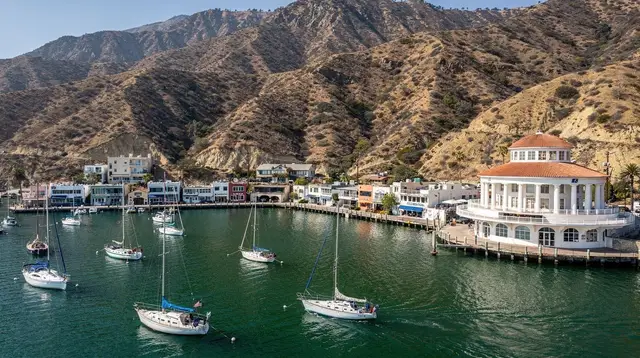
Long Beach’s other defining role in a Los Angeles itinerary is as a gateway to Catalina Island. Ferries to the island depart from Downtown Long Beach, near the waterfront and marina area, with a crossing time of roughly an hour out to Avalon, the island’s main town. This is a meaningful practical point: the ferry terminal is a specific, fixed location in downtown, not something reachable from just anywhere along the Long Beach coast. Visitors planning a Catalina day trip need to get themselves to that particular terminal, whether by car, Metro plus a short local connection, or rideshare, rather than assuming any beach or marina in the city will do.
Because of this, Long Beach works well as a staging point: arrive in the morning, spend a couple of hours around the waterfront or aquarium, then catch a ferry out to Catalina for the afternoon, or use Long Beach as the return leg after a night or day on the island. San Pedro, just across the harbor, also runs Catalina ferries from a separate terminal, so it is worth double-checking which departure point a booked ticket actually uses.
How Long Beach compares to nearby coastal spots
Long Beach is often mentally grouped with Marina del Rey, since both combine a marina with a residential coastal setting, but the comparison only goes so far. Marina del Rey is a smaller, primarily recreational boating harbor much closer to central Los Angeles, with a marina scaled for pleasure craft rather than global shipping. Long Beach operates at an entirely different scale: it is a major commercial port city with its own distinct downtown, not a marina neighborhood attached to a larger urban core.
The comparison to Venice Beach and Malibu is more about access than character. Both of those are prized for their beach culture and coastline but require a car or a long rideshare from central LA, with no practical rail option. Long Beach trades some of that classic beach-town atmosphere for direct Metro access and a genuinely different urban texture: working harbor, Art Deco downtown, and a real city rather than a beach enclave.
| Destination | Defining feature | Reachable by Metro? |
|---|---|---|
| Long Beach | Working port + revitalized downtown | Yes, via the A Line |
| Marina del Rey | Small recreational boating marina | No |
| Venice Beach | Beach culture, boardwalk, canals | No |
| Malibu | Coastal homes, Pacific Coast Highway | No |
Practical notes for a visit
A day in Long Beach pairs reasonably well with a half-day focus rather than trying to cover the whole city. Downtown, the waterfront and the marina area are walkable once there; the port itself, while visible and part of the city’s character, is an active industrial facility and not set up as a visitor attraction beyond viewing it from a distance. Parking downtown and near the waterfront generally costs a similar range to other dense parts of the Los Angeles area, and displayed prices at restaurants and shops exclude sales tax, with a tip expected on top at any sit-down meal.
For travelers curious about the wider Southern California coastline and looking to see multiple beach towns and harbor cities in a single loop, several guided options operating out of the Santa Monica area cover the broader coastline.
For a sense of how the coast looks from a different angle, a celebrity-homes-and-beaches route along the Malibu coastline departing from Santa Monica gives useful context on how varied the Los Angeles coastline is from one end to the other, and a similar small-group beaches and homes route from Santa Monica covers comparable ground for travelers based on the Westside rather than in Long Beach itself.
Travelers splitting time between the coast and the city’s better-known landmarks sometimes pair a Long Beach or Catalina day with a stop at Griffith Observatory; a guided insider visit to Griffith Observatory is a practical way to see it without worrying about the area’s limited parking. Others prefer to combine a beach-focused day with the classic photo stop at the Hollywood Sign, which a Santa Monica Pier and Hollywood Sign tour covers in a single outing.
Long Beach FAQ: getting there, the port and Catalina ferries
Can I get to Long Beach from Downtown LA without a car?
Yes. The Metro A Line runs directly from Downtown LA to Downtown Long Beach with no transfers required, making it one of the few coastal spots in the Los Angeles area that does not require driving or a long rideshare to reach.
Does the Metro A Line cover all of Long Beach?
No. It connects Downtown LA to Downtown Long Beach and a handful of stops along the corridor, but large parts of the city, including outlying residential areas and much of the port, are not within easy walking distance of a station. A taxi or rideshare fills the gap for anywhere beyond the immediate downtown area.
Where do the Catalina Island ferries leave from?
Ferries to Catalina Island depart from a specific terminal in Downtown Long Beach near the waterfront and marina, not from any arbitrary point along the coast. The crossing to Avalon on Catalina takes roughly an hour. A separate terminal in nearby San Pedro also runs Catalina ferries, so it’s worth confirming which departure point a booked ticket uses.
Is Long Beach a beach destination like Santa Monica or Venice Beach?
Not primarily. Long Beach is a working port city first, with an aquarium, a revitalized downtown and a marina, rather than a boardwalk-and-sand beach town. Large stretches of its coastline are active harbor rather than swimmable beach.
How is Long Beach different from Marina del Rey?
Marina del Rey is a smaller recreational boating marina close to central Los Angeles. Long Beach is a much larger commercial port city with its own downtown, operating at an industrial scale that Marina del Rey does not approach.
How long does the drive from Downtown LA take?
Roughly 30 to 45 minutes outside of peak traffic. Like most driving in the Los Angeles area, the same route can take noticeably longer during weekday morning and evening rush hours.
Is Long Beach worth visiting as a day trip on its own?
It can be, particularly for the aquarium and waterfront, but many visitors use it as a practical stop on the way to or from Catalina Island rather than a standalone destination, given that its appeal is more about the port city atmosphere than classic beach time.
What’s the best time of year to visit Long Beach?
Late spring through early autumn generally offers the clearest skies and least marine-layer cloud, though like the rest of the coastal Los Angeles area, mornings in late spring and early summer can stay overcast longer than inland areas.