Accessible Los Angeles: A Realistic Planning Guide
Is Los Angeles easy to visit for travellers with mobility needs?
It is manageable but car-dependent: the region is too spread out to rely on walking, and LA Metro only covers parts of it (Downtown, Hollywood, Koreatown, Santa Monica, Long Beach). An accessible rental car booked in advance is the most reliable way to reach most attractions.
What “accessible” means differently in Los Angeles
Most accessibility guides for a city assume a compact core: a historic centre where step-free routes, kerb cuts and public transport connect the main sights within a short radius. That model does not apply to Los Angeles.
The city is a basin-wide patchwork of districts and independent cities, and neighbourhoods that sit close together on a map — Hollywood, Beverly Hills, West Hollywood, Downtown LA — can still be 30 to 60 minutes apart by car depending on traffic. There is no single walkable centre to plan around, which changes the basic accessibility question: it is not “which sights have ramps,” but “how do I move reliably between sights at all.”
This page focuses on the mobility layer of a Los Angeles trip specifically for the core visitor area — Downtown, Hollywood, Griffith Observatory, Beverly Hills, West Hollywood and Pasadena — and is intentionally narrower in scope than a general planning guide. If you are weighing Los Angeles against a smaller, more walkable California city for an accessible trip, see our companion piece on Santa Barbara accessibility, which covers a genuinely different scale of city.
The core constraint: distance, not just terrain
For most cities, an accessibility guide is mainly about kerb cuts, step-free entrances and lift access. In Los Angeles, distance is the first constraint, before any of that. The Los Angeles metropolitan area covers a vast basin ringed by mountains, and attractions that a visitor might expect to combine in a single day — the Hollywood Sign area, Beverly Hills, and Downtown LA — are genuinely separate trips, each requiring its own transport plan.
For a visitor with limited walking stamina or a mobility device, this matters more than it would in a compact city, because the fallback of “just walk a bit further if the direct route is inaccessible” is rarely realistic. Detours caused by an inaccessible route, a blocked kerb cut or a construction closure are measured in additional driving minutes, not extra blocks on foot. This is the central planning reality of an accessible LA trip: plan around a small number of areas per day, each reached by car, rather than a single continuous walking route.
A realistic accessible car is the anchor of the trip
Because so much of the region is not realistically reachable without one, a rental car — reserved in advance with any adaptive equipment you need (hand controls, a wheelchair-accessible van, extra loading space) — is the most reliable single decision you can make for an accessible Los Angeles trip. Accessible vehicle inventory is limited relative to standard rentals, and demand is highest around major holidays and theme park season, so booking early matters more here than for a standard rental.
A few practical notes specific to accessible driving in LA:
- Parking, not distance, is often the real bottleneck. Attractions like Griffith Observatory have limited on-site parking that fills at sunset and on weekends; overflow parking can mean a longer walk than the observatory itself requires.
- Accessible parking placards from other US states and many countries are generally honoured in California, but always confirm current reciprocity rules before you travel, since requirements can change.
- Freeway driving is unavoidable for a multi-area itinerary. If highway driving with a mobility device or specific seating needs is a concern, build in extra time and avoid scheduling anything tight around rush hour, when the same drive can take twice as long.
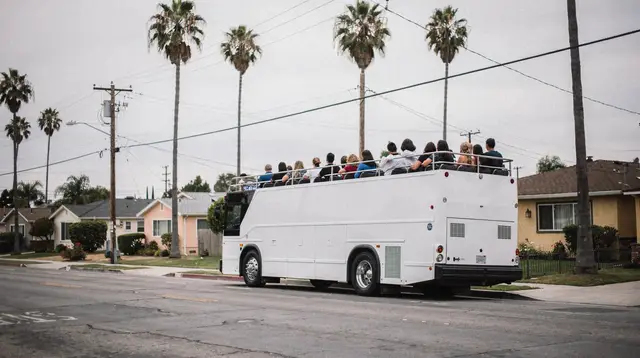
a private, door-to-door Los Angeles tour that can be tailored to specific mobility needs is often a more practical option than a self-driven itinerary for visitors who want the flexibility of a car without arranging one themselves, since the vehicle, route and pacing can be discussed with the operator in advance.
What LA Metro can and cannot do for you
LA Metro’s rail and bus network is a genuine accessibility asset within its coverage area, and it should not be dismissed. Trains and buses are equipped with lifts or low floors, priority seating and audible stop announcements, and stations along the core lines are built to modern accessibility standards. Where it works well:
- Downtown LA, served directly by multiple rail lines and a hub at Union Station.
- Hollywood, on the Red Line, useful for reaching Hollywood Boulevard without driving or parking there.
- Koreatown, on the same corridor as Hollywood and Downtown.
- Santa Monica, via the E Line, which also passes through parts of the Westside.
- Long Beach, via the A Line, a useful option if Long Beach is part of your itinerary.
What it does not do is connect the region as a whole. Beverly Hills, West Hollywood, Griffith Observatory and Pasadena either have no direct rail connection or require a transfer to bus routes with less predictable accessibility conditions stop by stop.
Metro is a genuinely useful tool for specific legs of a Los Angeles trip, not a citywide alternative to a car — treating it as the latter is the single most common planning mistake for visitors trying to travel accessibly here on a tight budget. If a car-free approach is the goal for at least part of the trip, our broader piece on whether LA Metro covers enough of the city is a useful companion read, alongside a general look at renting a car versus using rideshare in Los Angeles.
Ride-hailing services (Uber, Lyft, including accessible vehicle options where available in the app) can fill some of the gaps Metro leaves, particularly for point-to-point trips within a single district, but availability of wheelchair-accessible vehicles through these apps is inconsistent in Los Angeles and should not be relied on as a guaranteed option for a specific time slot.
District by district: what to expect
Downtown LA (DTLA)
Downtown is one of the more consistently accessible districts, with newer developments around the Arts District and Grand Central Market generally offering step-free entrances and modern sidewalks. Union Station itself is fully accessible and functions as a useful anchor point if you are combining rail travel with a car for the rest of the day. Older blocks further from the station can have more uneven paving, so route-check specific streets if a fully step-free path matters to you.
Hollywood and Hollywood Boulevard
Hollywood Boulevard itself is a flat, paved tourist corridor with generally reliable kerb cuts, and the Walk of Fame stars are set into a level sidewalk. The area immediately around it can be crowded, which affects manoeuvring space more than physical accessibility. Reaching Hollywood by Metro is straightforward from Downtown or Koreatown.
Griffith Observatory and the Hollywood Sign
This is the area where expectations most need adjusting. Griffith Observatory itself — the building, its main exhibit halls and its principal terraces — is step-free and free to enter, with a separate, paid, timed ticket only required for the planetarium show inside. The real-world constraint is parking: the lot is limited, fills early on weekends and at sunset, and an accessible-permit space does not guarantee proximity if the lot is already full.
The Hollywood Sign itself cannot be approached on foot from any accessible, step-free route. There is no paved path to its base for any visitor. The available viewpoints — from the observatory grounds, from Lake Hollywood Park, or from marked spots along Griffith Park trails — each involve some combination of walking, uneven terrain, elevation change or unpaved surface, and conditions vary by exact spot and by the season.
If a Hollywood Sign view is a priority, treat it as something to research and verify for the specific viewpoint you are considering, rather than assuming any single option is fully step-free. Our dedicated Hollywood Sign and Griffith guide covers the individual viewpoints in more detail.
For a lower-effort alternative that avoids walking or hiking entirely, an aerial helicopter tour over Los Angeles landmarks offers views of the sign and the wider basin from the air, without requiring any approach on foot.
Beverly Hills and Rodeo Drive
Beverly Hills is compact by LA standards and generally well maintained, with wide, flat sidewalks along Rodeo Drive and the surrounding shopping streets. It has no direct Metro connection, so reaching it means driving, rideshare, or a Metro-plus-bus combination.
West Hollywood
West Hollywood is similarly walkable within its own boundaries, particularly along Santa Monica Boulevard and the Sunset Strip corridor, but like Beverly Hills it is not on the rail network and requires a car or rideshare to reach and to leave.
Pasadena
Pasadena is a partial exception to the car-dependency pattern: its historic Old Pasadena district is walkable once you arrive, and it has its own Metro Gold Line-descended rail connection back toward Downtown, making it one of the easier outlying districts to combine with a Downtown- or Hollywood-based accessible itinerary.
Practical planning approach
Given the constraints above, the most reliable way to build an accessible Los Angeles itinerary is to group your days by area rather than by attraction type, and to confirm accessibility details for each specific stop rather than assuming a citywide standard:
| Area | Best access method | Notes |
|---|---|---|
| Downtown LA | Metro rail or car | Most consistently accessible district |
| Hollywood / Hollywood Boulevard | Metro rail or car | Flat, paved corridor |
| Griffith Observatory | Car (parking limited) | Building is step-free; Hollywood Sign viewpoints are not |
| Beverly Hills | Car or rideshare | No direct Metro connection |
| West Hollywood | Car or rideshare | No direct Metro connection |
| Pasadena | Metro rail or car | Walkable historic core |
A guided option removes much of this planning burden. a guided city highlights tour that groups the major districts into a single planned route handles the logistics of moving between areas, which can be useful if coordinating an accessible vehicle for a full self-driven itinerary is not practical. For a broader first orientation to the city that still keeps transport off your plate, a general orientation tour of Los Angeles covers several of the districts above in one outing.
If your trip extends beyond the core area covered here — into the beaches, Orange County or the desert — expect the same car-dependency pattern to intensify rather than ease, since those areas have little to no Metro coverage at all. Our general accessibility notes for the wider region and transport-focused planning guide go into more detail on that wider footprint.
What not to assume
Two assumptions consistently cause problems for visitors planning an accessible Los Angeles trip, and both are worth stating plainly:
- Do not assume LA Metro is a full substitute for a car. It genuinely works for a handful of corridors — Downtown, Hollywood, Koreatown, Santa Monica, Long Beach — and genuinely does not reach most of the rest of the region, including Beverly Hills, West Hollywood and the areas around Griffith Observatory beyond the observatory itself.
- Do not assume any Hollywood Sign viewpoint is step-free. Every option involves outdoor walking or hiking to some degree, conditions vary by specific spot, and none should be booked or planned around without checking that particular location’s terrain first.
Building an accessible Los Angeles itinerary around these two limits — rather than around the hope that a compact, transit-friendly city core exists somewhere in LA — is what makes the difference between a trip that goes smoothly and one that runs into avoidable friction on day one.
Accessible Los Angeles: frequently asked questions
Is LA Metro wheelchair accessible?
Metro rail stations and buses are equipped with lifts, ramps and priority seating, but the network itself only reaches a fraction of the region. It works well for Downtown LA, Hollywood, Koreatown, Santa Monica (via the E Line) and Long Beach (via the A Line), and is not a substitute for a car everywhere else.
Can I get close to the Hollywood Sign in a wheelchair or with limited mobility?
No. There is no paved, step-free path to the sign itself. Viewpoints such as Griffith Observatory or Lake Hollywood Park involve walking or hiking on outdoor terrain, and each one needs to be checked individually before you plan around it.
Is the Getty Center accessible?
Yes, in the parts that matter most: paid parking at the base of the hill connects to a free tram up to the museum, and the galleries and grounds are step-free. The tram ride itself is required for everyone, including visitors who arrive by taxi or rideshare.
Do I need a rental car if I use a wheelchair or have limited walking stamina?
For most itineraries, yes. Distances between neighbourhoods that look close on a map are commonly 30 to 60 minutes apart by car, and many attractions such as the Getty Center or the beaches are not realistically reachable without one. Reserve an accessible or hand-control vehicle well ahead of your trip.
Are Los Angeles sidewalks reliable for wheelchair users?
It varies block by block. Newer commercial districts and tourist corridors tend to have consistent curb cuts, while older residential streets can have uneven paving, missing ramps or construction detours. Treat sidewalk accessibility as something to verify locally, not assume citywide.
Is Griffith Observatory itself accessible even if the surrounding trails are not?
The observatory building, its exhibit halls and its main terraces are step-free once you are on site, and general admission is free. The constraint is usually parking, which is limited and fills up at peak times, and the walk from an overflow lot can be longer than expected.
How does Los Angeles compare to Santa Barbara for accessible travel?
Santa Barbara is smaller and more walkable, with a compact downtown that shortens the distances between accessible stops. Los Angeles is on a different scale: the sprawl and the patchwork of independent cities make a car close to essential for a full itinerary, even though individual sites within LA can be just as accessible as their Santa Barbara counterparts.
Accessible tours
Verified deep-linked GetYourGuide tours. Book through these links and we earn a small commission at no cost to you.
GetYourGuide does not provide a product photo for this activity — the image shows the meeting point, photographed by us.