Bike and Scooter Tours in Los Angeles: Downtown, Hollywood and the Hills
Are bike and scooter tours a good way to see central Los Angeles?
Yes for a single district at a time — Downtown, Hollywood, or Beverly Hills and West Hollywood are each realistic on two wheels. No single tour covers all of them, since they sit 30 to 60 minutes apart by car and are separated by real hills, especially around Griffith Park and Beverly Hills, so most operators specialize in one area rather than stitching the whole basin together.
A different kind of ride than the beach path
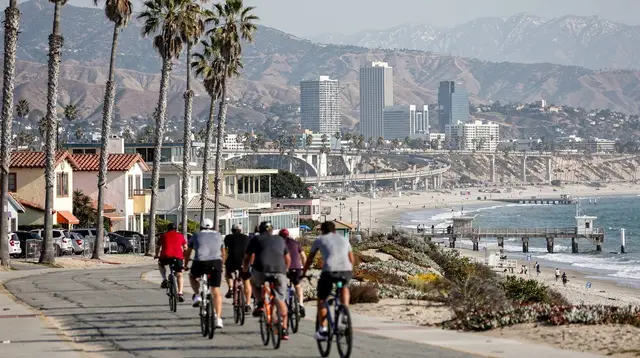
Most visitors who picture a Los Angeles bike tour picture the flat, car-free path along the sand in Santa Monica or Manhattan Beach — pleasant, easy, ocean-facing, and genuinely a different product from what’s covered here.
This guide is about riding through the urban core instead: Downtown LA, Hollywood, the approach to Griffith Observatory, Beverly Hills, West Hollywood and Pasadena. These routes trade the flat waterfront for street grids, hills, plazas, murals and film-history landmarks, and they ride very differently as a result.
The core fact to plan around: these districts look close together on a map of Los Angeles, but they are not close in practice. Downtown to Hollywood is a real drive, Hollywood to Beverly Hills is another, and Pasadena sits apart from both across the hills to the northeast. Depending on traffic, moving between any two of them by car commonly takes 30 to 60 minutes, and a bike or scooter obviously does not close that gap faster. No tour realistically strings all of these neighborhoods together in one outing — operators build routes around a single district, or at most two adjacent ones, and that is the sane way to think about booking one.
Why the urban core rides differently from the coast
Three things separate a Downtown or Hollywood bike tour from a beach ride, and all three matter for what to expect on the day.
Terrain. The coastal bike path is essentially flat for its entire length. The urban core is not. Streets around Beverly Hills climb steadily toward the foothills, and any route that approaches Griffith Observatory involves a genuine, sustained climb — one reason nearly every organized tour in this part of the city uses electric-assist bikes rather than standard ones. The assist makes the climbs manageable for an average rider, but it does not turn them into a flat cruise; expect to feel the hills even with a motor helping.
Traffic. Downtown and Hollywood are real city streets with real car traffic, signalled intersections and, in places, dedicated bike lanes that come and go rather than forming one continuous protected network. A guided tour generally routes around the busiest arterials and picks calmer side streets where possible, but riding here still means sharing the road with drivers — an e-bike’s motor changes how hard the pedaling is, not how many cars are around. Treat “electric” and “car-free” as two separate claims; only the first one is accurate here.
Transit coverage. LA Metro rail reaches Downtown, Hollywood and Pasadena reasonably well, which is part of why those three areas support more walk-up and transit-accessible tour meeting points. Beverly Hills and West Hollywood sit largely outside the rail network, so most riders get to a tour’s start there by car or rideshare rather than train — worth factoring into a day that also involves parking.
Comparing the two approaches
| Urban core tours (this guide) | Coastal bike path tours | |
|---|---|---|
| Districts covered | Downtown, Hollywood, Griffith area, Beverly Hills, West Hollywood, Pasadena | Santa Monica, Venice, Manhattan Beach, South Bay |
| Terrain | Hills, especially near Griffith Park and Beverly Hills | Flat, paved beach path (The Strand) |
| Bike type used | Almost always e-bike | Standard bike or scooter both common |
| Traffic exposure | Real city streets, mixed with bike lanes | Mostly car-free path |
| Typical length | 2-4 hours | 1.5-3 hours |
| Best for | Landmarks, film history, architecture, skyline views | Ocean views, boardwalk atmosphere, easy pace |
Downtown LA on two wheels
Downtown LA is one of the more bikeable pockets of the city precisely because its grid is compact and walkable by LA standards, with Metro rail feeding directly into it. A Downtown-focused ride typically threads through the Historic Core, past Grand Central Market, toward Union Station and into the Arts District, covering more ground in two hours than most visitors would walk comfortably in the same time given the sprawl described in how many days to plan for Los Angeles.
a guided express bike route through Downtown’s historic core and Arts District is built for exactly this — a focused loop rather than an attempt to also reach Hollywood or the Westside in the same booking. Riders looking for a broader single-day overview that mixes biking with other transport can also compare it against a guided city highlights tour covering multiple central districts, which trades some of the on-bike time for wider geographic reach.
Hollywood, the Sign and Griffith Park by e-bike
Hollywood is where the climb becomes unavoidable. The Hollywood Sign cannot be reached on foot from the boulevard below, and it is viewed from marked overlooks in Griffith Park and the surrounding hills rather than up close. E-bike routes through this area typically ride from Hollywood Boulevard up toward those viewpoints, letting riders reach elevations that would be a serious uphill slog on a standard bicycle in a fraction of the effort — though “a fraction of the effort” still means a real climb, not a flat glide.
a small-group Hollywood e-bike tour that rides toward Sign viewpoints and neighborhood landmarks is the more targeted option for this specific district. Because these routes are popular around golden hour, when the Sign and skyline views are at their best, booking a few days ahead is a reasonable habit even though it isn’t a strict requirement for most operators.
Reaching the Griffith Observatory grounds themselves is a separate question from riding toward Griffith Park in general — some routes stop at lower viewpoints rather than the Observatory plaza itself, since parking and crowd limits near the summit apply to cyclists and pedestrians as much as drivers. Confirm with the specific tour whether the Observatory building is an actual stop or a distant viewpoint.
Beverly Hills, West Hollywood and the flatter stretches in between
Beverly Hills and West Hollywood sit adjacent to each other and share some of the flattest, most bikeable streets in this part of the city — Rodeo Drive’s surrounding blocks and the Sunset Strip corridor both lend themselves reasonably well to a slower-paced ride past architecture and storefronts rather than a workout. That said, the foothill streets north of Sunset climb quickly, and any route that ventures up toward the hillside neighborhoods above Beverly Hills reintroduces the same elevation challenge found near Griffith Park.
A multi-stop route that links central Hollywood with Beverly Hills gives a sense of both without pretending they’re the same neighborhood — for a look at how a guided vehicle-based tour handles that same pairing (useful context even for cyclists deciding how much ground is realistic in one outing), a guided highlights tour spanning Hollywood, Beverly Hills and beyond shows roughly how much distance and time that combination takes by vehicle — generally more than a single bike route would attempt on two wheels in the same window.
Pasadena: a quieter, flatter alternative to the Hollywood hills
Pasadena sits apart from the rest of this list geographically — northeast of Downtown and Hollywood, connected by its own Metro rail line, and considerably flatter around its historic core than the hillside districts to the west. Riders who want the urban-landmark style of tour without the steep climbs near Griffith Park or Beverly Hills often find Pasadena’s Old Town and Colorado Boulevard corridor a gentler match, at the cost of being a separate trip from the rest of central LA rather than something combined into the same outing.
Seasonality and timing
Southern California’s mediterranean climate keeps these tours viable in every month of the year, which is not true of every activity in the region. The main adjustment is timing rather than season: inland afternoons in summer run noticeably hotter than the coast, sometimes by 10°C (about 20°F) or more on the same day, and a two-to-four-hour ride through Downtown or Hollywood in the mid-afternoon August sun is a different experience than the same route at 9am or in the two hours before sunset. Morning or late-afternoon departures are the more comfortable choice from roughly June through September; the rest of the year, timing matters less.
Coastal mornings can also bring May Gray and June Gloom — overcast skies that linger longer near the water than inland — but this affects the coastal bike-path tours described above more than the Downtown and Hollywood routes covered here, which sit further from the marine layer’s reach.
A one-day itinerary versus a multi-district trip
Trying to combine Downtown, Hollywood and Beverly Hills bike routes into a single day is possible in theory but rarely satisfying in practice, since transfer time between meeting points eats into the actual riding window. A more realistic pattern: pick one district’s tour as the anchor for a day that also includes walking or a short drive to adjacent sights, following something closer to a one-day Hollywood and Griffith itinerary or a one-day Downtown and Koreatown itinerary built around one core area rather than several.
Visitors assembling a longer trip and deciding how many bike-tour days to include can also compare this urban-core approach against the Santa Monica and Venice bike scooter tours guide, which covers the flatter coastal alternative referenced throughout this page, or check whether renting a car makes sense for the rest of the trip alongside a day or two on two wheels.
Riders who want a single organized day that folds biking into a broader look at the city, rather than a bike-only outing, might also consider a full-day guided bike adventure covering multiple Los Angeles landmarks, which is built specifically around the idea of seeing more than one district’s highlights in a single, paced route.
Choosing between an urban ride and the coast
For visitors staying near the water and short on time, a guided coastal e-bike tour along the beach path remains the easier, flatter option and pairs naturally with a beach-focused day rather than a landmark-focused one. It is a genuinely different product from everything else described on this page, and neither approach is a substitute for the other — the honest framing is two separate categories of ride, not a better-or-worse comparison. Anyone deciding between the two is really deciding between a beach day and a city day, and booking the corresponding tour accordingly.
Practical notes before booking
- Group size and pace: small-group e-bike tours (roughly 6-12 riders) are the norm in Hollywood and Downtown; confirm the group size if a quieter pace matters.
- What’s included: most operators include the e-bike, helmet and a guide; water, food and any Observatory-specific tickets are typically separate.
- Fitness level: electric assist lowers the bar considerably, but riders should still expect some real climbing near Griffith Park or the hills above Beverly Hills — this is not a flat cruise.
- Parking near meeting points: Beverly Hills and West Hollywood meeting points often mean paid parking or rideshare, since rail coverage is thin there compared with Downtown or Hollywood.
- Booking window: sunset-timed Hollywood routes and weekend Downtown departures are the ones most likely to sell out; a few days’ advance booking is a reasonable habit.
Bike and scooter tours in central Los Angeles: frequently asked questions
Can one bike tour realistically cover Downtown, Hollywood and Beverly Hills in a single outing?
No. These districts are 30 to 60 minutes apart by car depending on traffic, and no bike or scooter route closes that gap efficiently. Tour operators build routes around one district or a couple of adjacent ones, not the whole urban core in one sitting.
Does an e-bike remove the need to deal with car traffic?
No. An electric assist makes hills like the approach to Griffith Observatory or the streets above Sunset far more manageable, but riders still share real roads with Los Angeles traffic on most urban routes. Guided tours generally choose calmer streets and bike lanes where they exist, but they do not eliminate contact with cars.
Is Griffith Observatory included in most Hollywood-area bike tours?
Many Hollywood-area e-bike routes ride toward Griffith Park and stop at viewpoints for the Hollywood Sign, though reaching the Observatory itself involves a genuine climb — one reason e-bikes are the norm rather than standard bicycles on these routes. Confirm with the specific operator whether the Observatory grounds are part of the stop, since routes vary.
Does LA Metro cover the neighborhoods used on these tours?
Partially. Metro rail reaches Downtown, Hollywood and Pasadena reasonably well, which is one reason those three districts host more organized bike tours than hillier, transit-poor areas like Beverly Hills. Beverly Hills and West Hollywood have much thinner rail coverage, so most visitors reach a tour’s meeting point there by car or rideshare.
What is the difference between a Downtown bike tour and a coastal bike tour in Santa Monica or Manhattan Beach?
Downtown, Hollywood and Pasadena tours ride through city streets, plazas and genuine elevation change, with traffic lights and hills part of the experience. Coastal tours in Santa Monica or Manhattan Beach mostly follow the flat, car-free beach bike path (The Strand), which is a different, easier kind of ride aimed at ocean views rather than urban landmarks.
Do these tours run year-round?
Yes, Southern California’s climate keeps bike and scooter tours viable in every season. The main adjustment is timing rides earlier in the day during summer, when inland afternoon heat away from the coast can make a two-hour ride considerably less comfortable than a morning departure.
Should I book a bike tour in central LA in advance?
For popular routes and weekend departures, yes. Small-group e-bike tours in Hollywood and Downtown commonly sell out, especially around sunset slots timed for Hollywood Sign views, so booking a few days ahead is a reasonable habit rather than a strict requirement.
Bike and Scooter Tours
Verified deep-linked GetYourGuide tours. Book through these links and we earn a small commission at no cost to you.
GetYourGuide does not provide a product photo for this activity — the image shows the meeting point, photographed by us.