Whale Watching from Newport Beach: What to Actually Expect
Is whale watching from Newport Beach worth it compared to Dana Point or Los Angeles?
Newport Beach offers the same stretch of Southern California coast as Dana Point and the Los Angeles-area harbors, with dolphins commonly seen most of the year and whales appearing seasonally depending on migration timing. It is a genuine, separate departure point in Orange County, not a lesser version of the others, and the right choice usually comes down to where you are staying rather than which harbor sees more marine life.
Newport Beach as a separate departure point
Newport Beach is a city in Orange County, distinct from the City of Los Angeles both administratively and geographically. It sits on the same stretch of Southern California coast as Los Angeles to the north and Dana Point to the south, and all three areas run boats out onto broadly the same offshore waters. That geographic overlap means the marine life on offer is similar across the three harbors, but Newport Beach is not a branch office of the other two: it has its own harbor, its own operators and its own departure schedule, and choosing it is really a question of where you are based rather than which harbor has better access to whales and dolphins.
Visitors comparing options often assume the nearest harbor to their hotel is automatically the “main” one for whale watching in the region. That is not quite right. Long Beach and the greater Los Angeles waterfront, Dana Point, and Catalina Island crossings all offer comparable trips, and none of them can promise a better guarantee of sightings than another on any given day, since the animals move along the coast rather than staying near one town. What differs between them is convenience: driving time from where you are staying, the schedule of departures, and the specific boats and trip lengths each harbor’s operators run.
What a Newport Beach whale watching trip actually involves
A typical outing leaves Newport Harbor on a boat operated by a licensed local company, with a naturalist or crew member on board to help spot and explain what is seen. Trips are usually reserved in advance rather than bought on arrival at the dock, since departure times and boat capacity are fixed. Trip length varies by operator and by the specific product: a standard cruise runs shorter than some of the extended “ultimate adventure” style trips, and the exact duration should always be checked on the listing itself rather than assumed.
a standard whale watching departure from Newport Harbor is the most common starting point for a first visit, while a longer, more in-depth whale watching adventure suits visitors who want more time on the water and are less pressed for schedule. Because sightings depend on the animals’ own movements and on weather, no operator can promise a whale will appear on a specific departure, and it is worth reading the cancellation and rebooking policy before paying.
Sea conditions matter more here than on a typical land-based tour. Wind, swell and marine layer fog can all lead a captain to delay, shorten or cancel a trip for safety, particularly outside the calmer summer months. Flexible or partially refundable bookings reduce the financial risk of a weather cancellation, and checking the forecast a day or two ahead helps set realistic expectations before committing to a specific time slot.
Dolphins versus whales: two different expectations
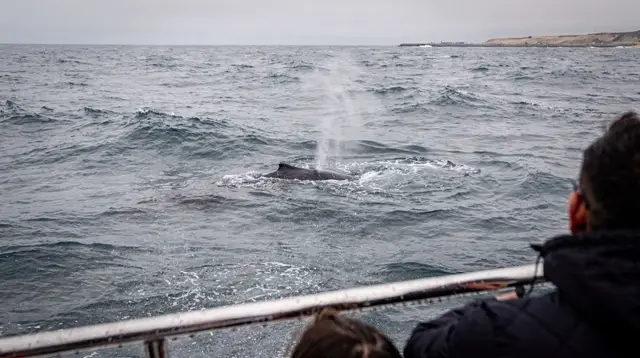
Dolphins, particularly common dolphins, are present in Southern California waters through most of the year and are seen on a large share of trips out of Newport Beach, Dana Point and the Los Angeles-area harbors alike. Large pods numbering in the hundreds are not unusual, and dolphin sightings are one of the more reliable parts of a typical cruise.
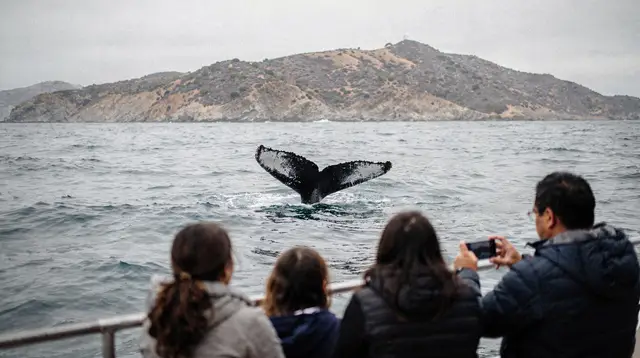
Whales are a different matter. Several species pass along this coast on different migration schedules, so which whale is most likely to be seen changes through the year. Gray whales are strongly associated with a southbound migration in the winter months and a return northbound migration in later winter and spring, while other species tend to appear more in the warmer months. This means “best season for whale watching” does not have one fixed answer — it depends on which species a visitor is hoping to see — and current local sighting reports close to a trip’s dates are a better guide than a general rule of thumb.
| What you might see | Typical pattern |
|---|---|
| Common dolphins | Present most of the year, often in large pods |
| Gray whales | Seasonal migration, mainly winter through spring |
| Other whale species | Seasonal, more associated with warmer months |
| Sea lions, seabirds | Frequently seen incidentally along the route |
Standard cruise or a longer adventure trip
Operators offer more than one style of trip, and these are genuinely different products rather than interchangeable versions of the same thing. A standard, shorter cruise suits visitors with limited time or a tighter schedule, while a year-round whale and dolphin watching cruise is built around consistent year-round departures rather than a single seasonal window.
Neither format increases the certainty of seeing a whale on a given day — that depends on the animals, the season and the weather, not on the boat or the ticket type. The practical differences between options are trip length, group size, amenities on board and price, and matching those to what a traveller actually wants out of the afternoon matters more than chasing a sighting guarantee that no legitimate operator will offer.
For a different kind of outing on the same harbor, some visitors prefer an evening cruise around Newport Harbor that is built around scenery and atmosphere rather than a search for marine life, which is a reasonable alternative for a slower-paced evening.
Boat size and group size also vary by listing. A larger vessel such as the one behind a Newport Beach whale and dolphin watching cruise tends to run on a fixed schedule with a bigger group, while a smaller boat used for a private whale and dolphin watching trip out of Newport Beach suits a family or small group that wants more control over timing and does not want to share the deck with strangers.
Neither option changes what is out on the water that day; it only changes who is on the boat with you and how much say you have over the departure time. Some operators also run premium vessels, and a catamaran-based whale watching cruise from Newport Beach is worth a look for travellers who would rather spend the afternoon on a more comfortable boat even if the wildlife itself is the same as on a standard tour.
Practical booking tips for Newport Beach whale watching
Because departures are scheduled and boats have a fixed capacity, booking ahead is the norm rather than showing up at the dock and hoping for space, especially on weekends and during school holidays when demand is higher. Checking the specific listing for start time, meeting point within Newport Harbor and what happens in case of cancellation is worth the few extra minutes it takes, since the answers vary by operator and are not standardised across the industry.
Dressing for the water is also easy to underestimate. Even on a warm day, the ocean breeze on an open boat is noticeably cooler than on land, and a layer that can come off if the sun is strong is more useful than dressing for the temperature on shore. Sunscreen and, for anyone prone to motion sickness, taking precautions before boarding rather than after the boat is underway both make the outing more comfortable regardless of what ends up being spotted.
Comparing Newport Beach with Dana Point and Los Angeles
The three areas are close enough that a visitor could plausibly base a trip out of any one of them, but they are not the same place and the driving time between them is real, not negligible. Newport Beach sits roughly between the greater Los Angeles waterfront to the north and Dana Point to the south, and the same rush-hour traffic patterns that affect the rest of Los Angeles apply here too — a drive that looks short on a map can take noticeably longer at peak times.
| Departure point | Administrative area | Typical draw |
|---|---|---|
| Newport Beach | Orange County | Harbor-based cruises, dolphins year-round, seasonal whales |
| Dana Point | Orange County, further south | Known regionally for whale watching, similar seasonal pattern |
| Los Angeles-area harbors | City/County of Los Angeles | Departures closer to central LA and the beach cities |
None of these locations should be treated as a guaranteed “better” option for sightings. The whale watching guide for Dana Point and the Los Angeles whale watching guide cover the same activity from those other departure points, and comparing them against this page is more useful for deciding on logistics — where you are staying, how much driving you want to do — than for deciding which harbor has more whales on a given day.
For travellers weighing Dana Point specifically, a Dana Point whale and dolphin watching tour covers the same coastline from that harbor, and a Los Angeles-area option such as a Long Beach whale and dolphin watching cruise gives a sense of what the northern end of the region looks like by comparison.
If a visitor is still deciding where to base a whole trip rather than just this one afternoon, the broader Orange County destination page and the Los Angeles day trips guide both help place Newport Beach within the wider region, alongside nearby Huntington Beach and Laguna Beach, which share the same coastline and are often combined with a Newport Beach stop on the same day.
Beyond whale watching in Newport Beach
Newport Harbor supports a range of other boat-based activities that pair naturally with a whale watching trip if time allows. Harbor cruises, including Newport Beach boat cruises more broadly, cover everything from casual sightseeing to themed evening outings. Travellers curious about the wider bay and its channels can also look at sightseeing tours around Newport Beach for options beyond wildlife-focused trips.
Newport Beach is also one of the departure points for the ferry crossing to Catalina Island, and the ferry crossing from Newport Beach to Avalon on Catalina Island is worth considering for visitors who want to combine a coastal outing with a day or overnight trip to the island.
The Catalina Island whale watching guide covers sightings from that side of the same waters, and the wider things to do in Newport Beach page and the general whale watching category page are useful starting points for comparing every departure option along the coast, including a look at Catalina Island as a day trip from Los Angeles for context on how the pieces fit together.
Common mistakes to avoid
Visitors sometimes assume Newport Beach is a neighbourhood of Los Angeles rather than its own city in Orange County, which leads to underestimating the drive between the two. Others assume a whale sighting is essentially guaranteed on any departure; it is not, and no operator should be trusted if it claims otherwise.
It is also a mistake to assume a private charter automatically improves the odds of seeing a whale — group size and comfort change, but the animals’ movements do not respond to ticket type. Finally, treating things to do in Dana Point and Newport Beach as fully interchangeable ignores that they are separate harbors with separate schedules, even though the coastline and the marine life they access largely overlap.
Frequently asked questions about whale watching from Newport Beach
Is Newport Beach in Los Angeles?
No. Newport Beach is an independent city in Orange County, south of Los Angeles and administratively separate from it, even though both sit along the same Southern California coastline.
Are whales guaranteed on a Newport Beach whale watching tour?
No responsible operator can guarantee a whale sighting on any given departure. Dolphins are seen on the large majority of trips year-round, but whale sightings depend on migration timing and vary by season and by day.
What is the best season to see whales from Newport Beach?
Different species pass through at different times, so “best” depends on which whale you hope to see; gray whales are most associated with the winter migration south and the spring migration north, while other species can appear in the warmer months. Checking current sighting reports close to your travel dates is more reliable than a fixed calendar rule.
How long does a whale watching cruise from Newport Beach last?
Durations vary by operator and by boat, and standard cruises are typically shorter than dedicated multi-hour adventure trips. Always check the specific listing for the departure you are booking rather than assuming a fixed length.
Can bad weather cancel a whale watching trip from Newport Beach?
Yes. These are boat trips on the open ocean, and sea conditions or weather can lead an operator to delay, shorten or cancel a departure for safety. Booking a refundable or flexible option reduces the risk if that happens.
Is Newport Beach whale watching different from Dana Point or Los Angeles departures?
The underlying activity is similar, since all three depart the same general Southern California coast, but each is a separate harbor with its own boats, schedules and operators. Newport Beach sits between the Los Angeles area to the north and Dana Point to the south, so proximity to your accommodation is usually the deciding factor.
Do I need to drive from Los Angeles to Newport Beach for this?
Yes, Newport Beach is a separate city roughly an hour or more from central Los Angeles depending on traffic and starting point, not a same-city outing. Building in extra driving time, especially around rush hour, is worth doing before booking a specific departure time.
Is a private whale watching charter worth it in Newport Beach?
A private charter and a standard shared cruise are different products with different costs, group sizes and flexibility, and neither one changes the underlying uncertainty of what marine life will be visible on a given day. Choose based on group size and budget rather than expecting a private trip to guarantee better sightings.
Whale Watching Trips
Verified deep-linked GetYourGuide tours. Book through these links and we earn a small commission at no cost to you.
GetYourGuide does not provide a product photo for this activity — the image shows the meeting point, photographed by us.