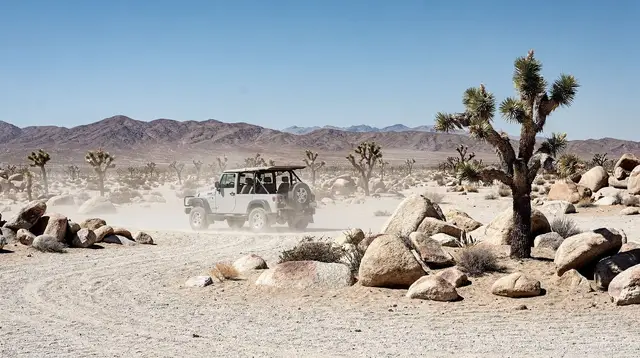
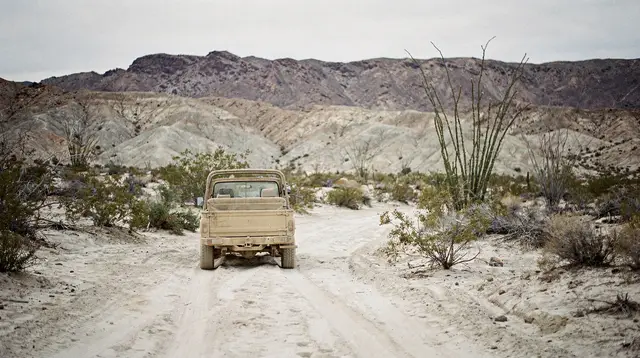
Anza & the San Jacinto Mountains: Jeep Adventures Above the Desert Floor
What kind of desert adventure is Anza and the San Jacinto Mountains known for?
Guided off-road jeep tours that climb from the low desert floor around Anza up into pine forest and ridgelines on the San Jacinto range, with a guide driving on unpaved backcountry tracks. It is a different experience from Joshua Tree's flat desert hiking and from Palm Springs itself, which sits at the base of the same mountains.
A desert with a mountain hiding inside it
Most visitors picture the Southern California desert as flat: sand, scrub, Joshua trees, a wide horizon under a hard sun. The area around Anza and the San Jacinto Mountains breaks that picture. Here, the desert floor rises sharply into a real mountain range, and the difference between the bottom and the top is not subtle — it is the difference between creosote scrub baking in full sun and shaded pine forest with cooler, thinner air. That contrast is the whole point of visiting, and it is best experienced from the seat of a guided off-road jeep rather than on foot from a single trailhead.
This is a different kind of desert adventure from what most first-time visitors to Southern California expect, and it is worth separating clearly from two places it gets confused with. Joshua Tree National Park is flat desert terrain, protected as a national park, and built around hiking trails, rock climbing and stargazing on largely level ground.
Palm Springs is the resort town at the base of the very same San Jacinto range, reached by car from Los Angeles and known for its hotels, restaurants and the Palm Springs Aerial Tramway, which lifts visitors straight up the mountain face in a rotating cable car. Anza and the San Jacinto backcountry sit apart from both: away from the national park boundary, away from the town centre, and defined by unpaved tracks that climb through the terrain rather than a marked trail system or a cable car cabin.
Why jeep, and why here
The terrain around Anza is not the kind of ground most rental cars are built for, and it is not realistically covered on foot in a single day given the elevation gain involved. Guided off-road jeep tours solve both problems at once. A local driver who knows the network of backcountry tracks takes the wheel, which means visitors get to focus on the surroundings rather than the driving, and the vehicle itself is built to handle loose surfaces, grades and the kind of terrain that would strand an ordinary car.
The routes typically start low, on desert floor scattered with creosote and scrub, and climb steadily toward the pine-covered upper slopes of the San Jacinto range. That climb is the experience: the vegetation changes visibly as the route gains elevation, the air cools, and the views open up over the desert basin below. A single jeep route can cover terrain that would otherwise require a demanding, multi-hour hike, condensed into a guided outing of a few hours.
Several operators run these routes with slightly different emphases. A general San Jacinto Mountains outing covers a broad cross-section of the terrain and elevation change in one trip — this is a reasonable first choice for a visitor who wants the full contrast between desert floor and pine forest without picking a narrower theme.
a guided off-road jeep adventure through the Anza and San Jacinto Mountains backcountryA route built specifically around Thomas Mountain focuses on one particular peak within the range, with its own character of pine forest, ridgeline views and quieter backcountry tracks away from the more heavily used areas.
a jeep off-road adventure focused on Thomas Mountain’s forested backcountryA “peaks and pines” route leans into the altitude contrast directly, moving between higher viewpoints and denser tree cover, which suits visitors most interested in the visual shift from open desert to mountain forest.
a peaks-and-pines off-road jeep tour with a local guideHow the altitude actually works
It is tempting to assume that because the San Jacinto Mountains rise well above the desert floor, a visit here automatically escapes the desert heat. That is only partly true, and it is worth being precise about it. The lower slopes and the desert floor around Anza still sit in the same broad desert climate as the rest of the Coachella Valley region, and they get genuinely hot for much of the year, particularly in summer. The relief comes only once a route climbs high enough into the pine-forest elevations, where temperatures drop meaningfully compared to the valley floor.
In practice, this means a summer jeep tour still starts in real desert heat before it reaches any cooler air, and the lower portions of any given route will not feel dramatically different from the desert floor elsewhere in the region. Altitude here is a partial buffer against the heat once you have gained enough of it, not a blanket exemption from a Southern California desert summer. Visitors who want to experience the cooler, forested upper elevations without contending with the hotter lower stretches are better served by choosing the cooler months.
That is also the logic behind the aerial tramway in nearby Palm Springs, which solves the same altitude problem in a completely different way — a cable car lifts visitors from the desert floor to a mountain station in minutes, without any driving or hiking at all.
the Palm Springs Aerial Tramway, which climbs the same San Jacinto range by cable carWhen to go
| Season | What to expect | Best for |
|---|---|---|
| November – April | Comfortable temperatures on both the desert floor and the upper elevations for most of the day | Full-day jeep routes, first-time visits, flexible timing |
| May – June | Warming daytime temperatures on lower sections; upper pine areas still comfortable | Morning or late-afternoon departures |
| July – September | Significant heat at lower elevations and on the desert floor before any climb begins | Early-morning departures only, shorter routes, extra water and sun protection |
| October | Cooling trend begins; conditions similar to spring by late month | Transitional-season visits |
November through April remains the most comfortable stretch for exploring this area without the lower-elevation heat working against the visit. A summer trip is not out of the question, but it rewards planning around the hottest hours rather than treating the mountain elevation as a fix for the season.
Getting there
Anza and the San Jacinto Mountains backcountry can be reached by car from two directions, and which one makes sense depends on the rest of a visitor’s itinerary. Coming directly from Los Angeles, the drive runs east through the Inland Empire before turning toward the mountains — a trip best planned outside the worst of LA’s rush-hour traffic windows, since the drive itself covers a meaningful stretch of freeway. Coming from Palm Springs, the area is a shorter, more direct drive, which makes it a natural add-on for visitors already based in the Coachella Valley for a few days rather than a dedicated day trip from the coast.
Either way, this is a car-dependent part of the region: there is no meaningful public transit covering the backcountry roads, and the jeep tours themselves are the only practical way to access the higher, unpaved sections of the terrain. Visitors without their own jeep-capable vehicle should treat a guided tour as the access method rather than an optional upgrade.
Booking basics — what to actually expect
Every guided jeep route in this area runs on a reservation system with a driver at the wheel, not a walk-up rental with visitors driving themselves. That single fact shapes how to plan a visit: departure times are fixed and limited per day, group sizes are capped to the vehicle, and a booking needs to be made ahead of arrival rather than assumed to be available on the day. There is no scenario in which a visitor simply turns up at a trailhead and finds an available jeep and guide waiting — the vehicles and drivers are working from a schedule, and unbooked slots are not held for casual arrivals.
Most routes run for a few hours, cover a defined loop or out-and-back track, and include narration from the guide about the terrain, vegetation change and history of the area. Because the driving is handled by the guide, no off-road driving experience is required of participants, which makes this a realistic option for visitors who would not attempt the terrain in a rental car themselves.
What to pack
The elevation swing on a typical route is the main packing consideration. A jacket or warm layer is worth carrying even on a hot day, since the pine-forest sections can be noticeably cooler than the desert floor where the route begins. Sun protection — hat, sunscreen, sunglasses — matters most in the lower, more exposed stretches, and water should be treated as essential rather than optional, particularly for anything booked outside the cooler months. Closed, comfortable shoes are the practical choice; open-backed sandals are a poor fit for a vehicle moving over uneven, unpaved ground.
Pairing Anza with the rest of a desert itinerary
Because Anza sits within a reasonable drive of both Palm Springs and the wider Joshua Tree area, it fits naturally into a longer desert-focused stretch of a Southern California trip rather than standing alone as a single-purpose destination. Visitors building a few days around Palm Springs and Joshua Tree commonly add a jeep day in the San Jacinto backcountry as a contrasting outing — trading the flat trails and rock formations of Joshua Tree National Park for a route defined by elevation change and forest.
A longer trip covering the broader desert region — Palm Springs, Joshua Tree and Death Valley — has room to include Anza as one day among several distinct desert environments, which helps avoid the common mistake of treating “the desert” as a single uniform place across a multi-day visit.
Within Joshua Tree itself, other guided outings lean into very different themes — from quiet reflection to family climbing days — and are worth knowing about even though they sit outside the jeep-and-altitude angle of this page.
a guided full-moon hike through Joshua Tree’s flat desert terrainAnza versus its neighbours, at a glance
| Area | Terrain | Signature activity | Distinct from Anza because |
|---|---|---|---|
| Anza & San Jacinto Mountains | Desert floor rising into pine-forested mountain backcountry | Guided off-road jeep tours on unpaved tracks | — |
| Joshua Tree National Park | Flat desert, granite rock formations | Hiking, rock climbing, stargazing | No significant elevation change; trail-based, not vehicle-based |
| Palm Springs | Resort town at the mountain’s base | Aerial tramway, hotels, restaurants | A town, not backcountry; cable car instead of jeep track |
| Big Bear Lake | Higher mountain lake basin further north | Lake recreation, alpine scenery | Different mountain range, further from the low desert floor |
Big Bear Lake is a useful comparison point rather than a substitute: it sits on a different mountain system further north, and visitors sometimes conflate “mountains near LA” as a single destination when the driving distance and the character of each place are quite different.
Other desert options near Anza
Anza is one piece of a much larger desert region, and it is worth knowing what else sits nearby for visitors weighing how to split their time. Los Angeles itself is the starting point for most of these desert day trips, and Palm Springs has its own roster of desert-adventure tours beyond the aerial tramway already covered above, from jeep routes to other guided outings around the Coachella Valley floor.
Within Joshua Tree specifically, the guided-tour landscape is broader than the full-moon hike already mentioned. A private backcountry tour covers ground a self-driven visit would miss entirely.
a guided backcountry tour of Joshua Tree National ParkRock climbing is another common draw in the same park, offered both as a general guided trip and as a private outing for families or small groups who want more one-on-one attention from an instructor.
a guided rock climbing trip in Joshua Tree National ParkFor the broader question of how a desert leg fits into a wider itinerary, Palm Springs versus Joshua Tree lays out how the two differ as a base, and visiting the desert in summer covers the heat-planning logic referenced earlier in more depth, since it applies just as much to Anza as it does to the rest of the region.
Travellers still deciding how many days to allocate across the desert overall may also find how many days in Los Angeles useful for fitting a jeep day into a longer coastal-plus-desert trip, and the Death Valley leg of the four-day desert itinerary mentioned above is the natural next stop for visitors who want to keep going deeper into the desert after Anza and Joshua Tree.
Common mistakes to avoid
Visitors sometimes assume Anza is simply part of Joshua Tree National Park because both sit in the same general desert region of Southern California; they are separate areas with different terrain, different activities and different access requirements, and confusing the two can lead to arriving with the wrong expectations — flat trail walking instead of a vehicle-based mountain climb, or vice versa.
It is also easy to overestimate what the elevation buys you in summer. The lower sections of any jeep route sit in real desert heat before the climb reaches cooler pine forest, so treating “it’s in the mountains” as a reason to skip sun protection or water on a summer booking is a mistake worth avoiding directly.
Finally, arriving without a reservation and expecting to book a jeep tour on the spot is not a realistic plan. These are guided, driver-operated experiences with limited daily capacity, and the booking needs to happen before the trip, not at the trailhead.
Anza and the San Jacinto Mountains: frequently asked questions
Is Anza the same as Joshua Tree National Park?
No. Joshua Tree National Park is a separate protected area of flat desert terrain known for hiking, rock formations and stargazing. Anza and the San Jacinto Mountains are a different area, further southwest, defined by elevation change and jeep-accessible backcountry tracks rather than a national park’s marked trail network.
Do I need to book a jeep tour in advance?
Yes. Guided jeep adventures in this area run with a driver at the wheel and operate on a booking system with limited daily departures. Vehicles and guides are not available on a walk-up basis, so reserving ahead is necessary rather than optional.
Does the altitude make the summer heat bearable?
It helps but does not solve the problem. The lower slopes and desert floor around Anza still get genuinely hot in summer, and only the higher pine-forest sections of the San Jacinto range offer meaningful relief. Treat the cooler air at altitude as a partial buffer, not protection from a Southern California desert summer.
When is the best time to visit Anza and the San Jacinto Mountains?
Roughly November through April, when daytime temperatures across both the desert floor and the mountain tracks are comfortable for a full day outdoors. Summer visits are possible but should be planned around the heat, especially at the lower elevations before the jeep route climbs.
Can I drive myself instead of taking a guided jeep tour?
Some of the roads in the wider region are open to visitors with a suitable vehicle, but the routes covered by guided jeep tours are typically unpaved backcountry tracks best handled by an experienced local driver who knows the terrain, current conditions and property boundaries.
How does Anza compare to Palm Springs for a day out?
Palm Springs is a resort town at the base of the San Jacinto Mountains, built around hotels, restaurants and the aerial tramway that lifts visitors straight up the mountainside. Anza is the quieter backcountry side of the same range, reached separately and centred on off-road jeep routes rather than a town centre.
What should I bring on a jeep tour in this area?
Layers make the biggest difference, since temperatures drop noticeably as the route climbs from the desert floor into pine forest. Sun protection, water and comfortable closed shoes are standard for the lower, hotter sections of most itineraries.
Is this a good stop to combine with Joshua Tree National Park or Palm Springs?
Yes. Anza sits within reasonable driving range of both, and travellers building a Palm Springs and Joshua Tree itinerary commonly add a jeep adventure in the San Jacinto backcountry as a contrasting, higher-elevation day within the same regional trip.
Desert Adventures
Verified deep-linked GetYourGuide tours. Book through these links and we earn a small commission at no cost to you.
GetYourGuide does not provide a product photo for this activity — the image shows the meeting point, photographed by us.