Los Angeles to Las Vegas Through the Desert: Multi-Day Routes and Stops
How do you plan a desert trip from Los Angeles to Las Vegas with stops?
The direct drive from Los Angeles to Las Vegas takes roughly four hours across open desert, but travelers who want to add Joshua Tree, the Grand Canyon or Antelope Canyon should plan a multi-day, one-way or looped route rather than a single day, since those detours add substantial driving time and often require booking accommodation and tours in advance. November through April keeps daytime desert temperatures more manageable for the driving stretches.
Why treat this as a route, not a destination
Most visitors think of the desert between Los Angeles and Las Vegas as something to cross, not somewhere to stop. That is true if the plan is a straight drive: the direct route covers roughly four hours of highway across open desert, and it can be done in a single push. But a growing number of travelers use that same corridor as the spine of a longer trip, threading in Joshua Tree National Park, the Grand Canyon or Antelope Canyon as planned stops rather than side trips from a single base.
This page is about that second approach: routes and multi-day circuits that link Los Angeles and Las Vegas through the desert, rather than single-location guides to Joshua Tree, Palm Springs or the Anza-Borrego area, which stay anchored to the Los Angeles region and are covered elsewhere on this site. If the goal is to see one desert spot and return to LA, a day trip from a fixed base makes more sense. If the goal is to move from Los Angeles to Las Vegas (or beyond, to the Grand Canyon) while seeing several desert highlights along the way, the routes below are the relevant ones.
The direct drive: what four hours actually means
The baseline figure is straightforward: Los Angeles to Las Vegas is about four hours of driving under normal conditions, covering roughly 270 miles (430 km) through the Mojave Desert on Interstate 15. That number gets repeated often enough that it can sound like a guarantee, but two things push it higher in practice.
First, traffic. The stretch leaving the LA basin through the Cajon Pass and the approach into Las Vegas both see heavy congestion at predictable times — Friday afternoons and evenings heading toward Las Vegas, and Sunday afternoons heading back toward Los Angeles. A four-hour drive can stretch well past six hours on those windows.
Second, the desert itself. Once past Barstow, the route runs through genuinely remote terrain with long gaps between services. In summer, that is not a minor detail: cars can overheat, and a mechanical problem in the middle of the day, in the open desert, is a serious situation rather than an inconvenience. It is one of the clearer reasons this guide repeats a point made elsewhere: the drive is a four-hour trip in good conditions, not something reliably done in under three hours.
a private transfer between Los Angeles and Las Vegas removes the driving and traffic-timing question entirely for travelers who would rather not manage the Cajon Pass or desert stretch themselves, though it does not add stops along the way.
Adding Joshua Tree without turning it into a detour
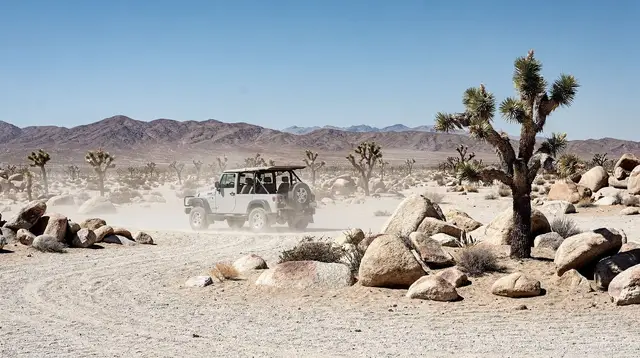
Joshua Tree National Park sits close enough to the general Los Angeles-to-Las Vegas corridor that many one-way itineraries route through or near it rather than treating it as a separate trip. The park itself deserves real time — its Joshua tree woodlands, boulder fields and desert vistas are not something to glimpse from a car window — so travelers adding it to a Los Angeles-to-Las Vegas route are generally looking at a half-day to full-day stop, not a fifteen-minute photo break.
a one-way tour between Las Vegas and Los Angeles that stops in Joshua Tree National Park is built specifically for this pattern: it moves travelers between the two cities in one direction while giving dedicated time in the park, rather than requiring a separate round trip from either base.
The tradeoff is time and structure. A one-way tour with a Joshua Tree stop takes longer than the direct four-hour drive, and it commits to a single direction of travel — useful for travelers who are, say, starting in Los Angeles and flying out of Las Vegas afterward, less useful for anyone who needs to return to the same base the same day.
Multi-day circuits: Grand Canyon and Antelope Canyon
The Grand Canyon and Antelope Canyon sit well beyond Las Vegas from a Los Angeles starting point — Antelope Canyon alone is roughly seven to eight hours from LA one way — which is why they appear almost exclusively on multi-day tours rather than single-day add-ons to the Las Vegas leg.
a four-day small-group tour from LA covering the Grand Canyon and Antelope Canyon is representative of how these circuits are structured: several long driving days connecting Los Angeles, the Las Vegas area, the Grand Canyon and Antelope Canyon, with the specific itinerary determining how much is spent in transit versus on site at each stop.
a guided tour linking Los Angeles, Las Vegas, the Grand Canyon and Antelope Canyon covers similar ground with its own pacing and stop order — worth comparing against the four-day option for whichever itinerary fits the available time better.
Two practical points apply to every version of this circuit. First, Antelope Canyon can only be entered with a Navajo-guided tour, and those guided slots are limited and often booked well in advance, particularly for the more photogenic Upper Antelope Canyon sections — a multi-day desert tour that includes it has effectively secured that access as part of the booking. Second, whether accommodation is included varies by tour: some multi-day options bundle hotel nights into the price, others cover transport and guiding only and leave lodging to the traveler to arrange separately.
This is the detail to check before booking, not after — the small desert towns along these routes (Page, Arizona, near Antelope Canyon, or the Grand Canyon’s South Rim gateway towns) have limited hotel capacity, and arriving without a confirmed room is a real risk, not a theoretical one. None of these circuits should be booked assuming rooms, transport or canyon access can simply be arranged on arrival.
Hoover Dam and Las Vegas as a shorter add-on
Not every desert stop needs a multi-day commitment. Hoover Dam sits directly on the route between Los Angeles and Las Vegas, close enough to Las Vegas itself that it works as a single add-on rather than a route in its own right.
a private one-day tour from Los Angeles to Hoover Dam and Las Vegas covers this pairing directly, combining the dam with time in Las Vegas in a single day rather than folding it into a longer desert circuit. For travelers who want a taste of the desert-and-dam scenery without committing to the Joshua Tree or Grand Canyon detours, this is the more contained option.
When the route continues past Las Vegas
For travelers using Las Vegas as a waypoint rather than an endpoint, evenings there are easy to fill before the next leg of a desert circuit. the Chippendales show at Planet Hollywood and Criss Angel’s Mindfreak show at Planet Hollywood are both straightforward evening bookings for a night spent in the city between driving days, without requiring any extra route planning.
Route options compared
| Route | Typical length | What it adds over the direct drive |
|---|---|---|
| Direct Los Angeles - Las Vegas | About 4 hours | Nothing extra; fastest point-to-point option |
| One-way with Joshua Tree stop | Half day to full day added | Dedicated time in Joshua Tree National Park |
| One-day Hoover Dam and Las Vegas | Single day from LA | Hoover Dam plus Las Vegas, no overnight desert stay |
| Multi-day Grand Canyon and Antelope Canyon | 3-4 days or more | Grand Canyon, Antelope Canyon, one or more overnight desert stops |
Choosing between a base-first trip and a route-first trip
The desert region around Los Angeles supports two different planning logics, and it helps to be clear about which one fits a given trip before booking anything.
A base-first trip picks one location — Palm Springs, Joshua Tree or the wider Anza-Borrego area — and radiates out from it for day trips, returning to the same hotel each night. This suits travelers who want to keep a single check-in and check-out and see one part of the desert well.
A route-first trip, the subject of this page, treats the desert as a corridor between Los Angeles and Las Vegas (or beyond, to the Grand Canyon), with stops chosen along the way rather than day trips from a fixed point. This suits travelers who are already planning to end up in a different city than they started, or who want to see several distinct desert landscapes rather than one area in depth.
Neither approach is better in the abstract; the choice depends on whether the itinerary needs to end somewhere other than Los Angeles. Anyone flying out of Las Vegas, continuing to the Grand Canyon, or simply preferring not to backtrack across the same highway twice is a route-first traveler, and the tours above are built for that pattern.
Timing the drive around desert heat
Seasonal timing matters more on this route than on most Southern California itineraries, because a meaningful portion of it runs through open desert with real heat exposure. Roughly November through April keeps daytime temperatures on the driving stretches in a manageable range for both vehicles and travelers stepping out at stops like Joshua Tree. Summer months bring daytime highs that make roadside breakdowns genuinely dangerous rather than merely uncomfortable, particularly on the more remote sections toward the Grand Canyon and Antelope Canyon.
This does not rule out a summer trip, but it does argue for extra preparation: carrying water, checking a vehicle’s cooling system before departure, and avoiding long stops in direct sun during the hottest mid-afternoon hours. Multi-day tours run with guides and support vehicles reduce this risk considerably compared with a self-driven trip in the same season.
Frequently asked questions about the Los Angeles to Las Vegas desert route
How long does it take to drive from Los Angeles to Las Vegas?
The direct route is roughly four hours of driving, covering open desert with limited services in some stretches. It is not a two-to-three-hour trip, and traffic leaving the LA basin or crossing into Nevada on a Friday evening or Sunday afternoon can add significantly more time.
Can Joshua Tree be added to a Los Angeles to Las Vegas route without much extra driving?
Joshua Tree National Park sits close enough to the general corridor between Los Angeles and Las Vegas that it works well as a stop on a one-way or multi-day itinerary, but it still adds hours of driving and a park entrance fee, so it is best treated as a planned overnight stop rather than a quick detour on the direct drive.
Do multi-day tours to the Grand Canyon or Antelope Canyon from Los Angeles include accommodation?
It depends on the specific tour. Some multi-day desert tours from the LA area bundle hotel nights into the price, while others cover transport and guiding only and leave lodging to the traveler. Always check what is included before booking, since a multi-day desert circuit without confirmed lodging can leave travelers stranded in towns with limited hotel capacity.
Do these multi-day desert tours need to be booked in advance?
Yes. Multi-day circuits to the Grand Canyon and Antelope Canyon involve fixed departure dates, timed entry slots at Antelope Canyon (which can only be visited with a Navajo-guided tour), and limited hotel inventory in small desert towns, so advance booking is standard rather than optional.
Is summer a good time to drive across the desert between Los Angeles and Las Vegas?
Summer is the riskiest season for this route. Daytime temperatures in the desert stretches regularly climb well above what most vehicles and travelers are used to, and services can be sparse between towns. November through April offers a much more comfortable window for the driving portions of a desert circuit.
What is the difference between a one-way Los Angeles to Las Vegas tour and a round-trip desert tour?
A one-way tour drops travelers in Las Vegas (or vice versa) after visiting stops such as Joshua Tree, which suits people continuing their trip from Las Vegas onward, for example by flying out or continuing to the Grand Canyon. A round-trip or day tour returns to the Los Angeles area, which suits a shorter desert taste without changing base.
Is Antelope Canyon reachable on a day trip from Los Angeles?
Not realistically. Antelope Canyon is roughly a seven-to-eight-hour drive from Los Angeles one way, well beyond the Las Vegas leg, which is why it appears on multi-day tours that also include the Grand Canyon and typically one or more overnight stays along the way.
Planning the rest of the trip
For travelers building this route into a longer Southern California stay, the seven-day Los Angeles and Las Vegas itinerary and the seven-day Grand Canyon, Las Vegas and desert itinerary lay out full day-by-day structures around these same stops.
Those staying closer to a single desert base rather than routing through to Las Vegas may find the Palm Springs desert adventures or Joshua Tree desert adventures pages a better fit, and the four-day desert itinerary covering Palm Springs, Joshua Tree and Death Valley is the base-first counterpart to the route described here.
General planning for the wider region, including car rental logistics, is covered in the Los Angeles day trips hub and the Los Angeles desert adventures category page, and the blog post on renting a car versus using rideshare in Los Angeles is worth reading before deciding whether to self-drive any part of this route. Those extending the trip toward San Diego instead of Las Vegas can compare notes on the Los Angeles versus San Diego page, and travelers weighing the desert against the coast may want the Palm Springs versus Joshua Tree comparison as well.
Desert Adventures
Verified deep-linked GetYourGuide tours. Book through these links and we earn a small commission at no cost to you.
GetYourGuide does not provide a product photo for this activity — the image shows the meeting point, photographed by us.