Los Angeles to Las Vegas: Transfers and Transport
What is the best way to get from Los Angeles to Las Vegas?
A rental car via Interstate 15 is the most flexible option, covering roughly 270 miles (430 km) in about four hours outside of traffic. A private transfer is a comfortable alternative for travelers who would rather not drive, but it follows the same road and is subject to the same traffic swings, particularly on Friday evenings and Sunday afternoons.
A different kind of trip from Los Angeles
Most of the transfers and transport pages on this site deal with getting around inside the Los Angeles region — a ride to San Diego or a short hop down to Carlsbad. Las Vegas is a different proposition entirely. It is not a suburb, a beach town or a day-trip neighbor; it sits in another state, across a stretch of open desert, and getting there is a genuine inter-state journey rather than a local transfer. Anyone planning to add Las Vegas to a Los Angeles itinerary needs to think about it on those terms: real distance, real desert, and a route that behaves very differently depending on the day and time you travel.
This page is about the practical side of that journey — driving it yourself, booking a private transfer, or considering a flight instead — and about the desert crossing that ties all three options together, whichever one you choose.
The distance, honestly stated
Los Angeles and Las Vegas are separated by roughly 270 miles (430 km) of road, almost all of it along Interstate 15. In free-flowing traffic, with no stops, that works out to somewhere around four hours behind the wheel. That figure is worth remembering, but it is also worth treating with some caution: it describes best-case conditions, not a guarantee.
The honest version of this fact is that four hours is what you get on a quiet weekday, mid-morning or mid-afternoon, when the highway is moving freely. It is not what you get leaving Los Angeles on a Friday evening, when tens of thousands of other travelers are making exactly the same trip for the weekend, or returning from Las Vegas on a Sunday afternoon, when the same crowd is heading home at once.
On those specific windows, the same 270 miles can easily take five, six or more hours, with long stretches of stop-and-go traffic through towns like Barstow and Baker that would otherwise be quick pass-throughs. If your schedule has any flexibility at all, shifting a Friday departure to earlier in the day, or a Sunday return to Monday morning, can save hours rather than minutes.
Driving yourself: still the default
For most visitors, a rental car remains the practical baseline for this trip, in the same way it is the baseline for getting around Los Angeles itself. The route is simple to follow — essentially Interstate 15 north-east out of the Los Angeles basin, through the Inland Empire, and out into open desert — and having your own car at the far end gives you full control over stops, timing and detours.
That flexibility matters more on this particular route than on most. The drive passes reasonably close to Joshua Tree and the wider Joshua Tree National Park area, and continues through genuinely remote desert before reaching Nevada. A driver can build in a stop, adjust departure time to dodge the worst of the traffic windows described above, or simply pull over if conditions call for it. None of that is available to the same degree with a scheduled transfer.
The tradeoff is the drive itself: four-plus hours through desert scenery that, while striking in its own way, does not offer much in the way of towns, services or shade for long stretches. It is not a difficult drive by American highway standards, but it is a long, exposed one, and that has real implications in summer (more on that below).
Private transfers: comfortable, not express
A private transfer between Los Angeles and Las Vegas is worth considering for travelers who would rather not spend four-plus hours driving themselves, particularly if the group includes people who prefer to relax, work or sleep during the journey rather than take turns at the wheel. Some services can also be arranged around an LAX airport transfer, which can simplify the logistics for visitors flying directly into Los Angeles and continuing straight on to Nevada rather than first making their way into the city.
a private transfer between Los Angeles and Las Vegas covers exactly this route, door to door, without requiring a rental car reservation, drop-off logistics or a designated driver.
It is important to be clear about what a private transfer does and does not change, though. It uses the same Interstate 15 corridor as every other vehicle making the trip, and it is subject to the same traffic patterns described above. A private transfer on a Friday evening will sit in the same congestion as a rental car on a Friday evening. What changes is comfort and convenience, not speed — this is not an express service, and it should not be booked with an expectation that it will reliably beat a four-hour drive. Framed accurately, it is a more relaxed way to make a long drive, not a faster one.
For travelers who want to see more of the desert along the way rather than simply transit through it, a guided option worth considering is a private day tour from Los Angeles to Las Vegas that also stops at Hoover Dam, which turns the transfer itself into part of the sightseeing rather than a pure point-to-point drive.
Driving in the other direction, with stops
Travelers who are ending their trip in Los Angeles after starting in Las Vegas, or who simply want to break up the return leg with sightseeing rather than a single long drive, have another option worth knowing about: a one-way guided journey that turns the return trip into its own small itinerary. A one-way tour from Las Vegas back to Los Angeles that routes through Joshua Tree National Park is built around exactly this idea — using the drive itself as a way to see part of the desert properly, with planned stops, rather than treating the highway as something to get through as quickly as possible.
This kind of option suits travelers who are not in a hurry and would rather build a half-day or full-day desert experience around the transfer than minimize the hours spent on the road.
Should you fly instead?
Given the distance, it is reasonable to ask whether flying between Los Angeles and Las Vegas beats driving. The flight itself is genuinely short — under an hour in the air — and that can make it tempting to assume it is automatically faster overall. That assumption does not always hold up in practice.
Door to door, a flight involves getting to the departure airport with enough buffer for check-in and security, the flight itself, and then getting from the arrival airport to your final destination in Las Vegas — typically the Strip or downtown. Add those segments together and the total time can end up in a similar range to a straightforward, off-peak drive, particularly for travelers who are not starting or ending right next to an airport. Neither option should be assumed to be the faster one without thinking through your specific starting point, arrival point and the time of day you are traveling. The honest answer is that it depends, not that one option always wins.
The desert crossing in summer
Whichever way you make this trip, it is worth taking the desert seriously, especially between roughly May and September. Interstate 15 crosses a genuinely hot stretch of the Mojave Desert, and summer daytime temperatures along this corridor regularly climb well past 40°C (104°F). That heat is not just uncomfortable — it is a real practical consideration for anyone driving themselves.
A few points worth planning around:
- Carry water. Breaking down or simply needing to pull over in extreme heat is far more serious without it.
- Check your vehicle’s cooling system before you leave, particularly on an older or heavily used rental car — desert heat is unforgiving on an engine that is already running hot.
- Keep the air conditioning running and fuel levels topped up. Services thin out considerably away from the main towns along the route, and running low on gas in the middle of a 100°F-plus stretch of desert is not a situation to plan around solving on the fly.
- Avoid the hottest part of the afternoon if you can, both for comfort and because vehicle strain is highest when ambient temperatures peak.
None of this makes the drive unsafe for a well-prepared traveler in a functioning vehicle — thousands of people make this exact trip every week. It does mean the desert crossing deserves a bit more respect than a similar-length freeway drive somewhere cooler and better serviced.
Building the desert into a bigger trip
For travelers who want to treat the Los Angeles-to-Las Vegas corridor as more than a point-to-point transfer, the surrounding desert offers enough to justify extra time. A guided multi-day option worth considering is a four-day small-group tour from Los Angeles covering the Grand Canyon and Antelope Canyon, which extends the desert crossing into a full loop through some of the region’s most striking landscapes rather than a single transfer day.
If you would rather plan the whole route yourself, the seven-day Los Angeles and Las Vegas itinerary lays out a full week that treats both cities as genuine destinations, and the four-day desert itinerary covering Palm Springs, Joshua Tree and Death Valley is a useful reference for travelers who want to explore more of the desert before or after the Las Vegas leg. The Death Valley area, while not directly on the Interstate 15 route, is a common add-on for visitors already committed to a desert-focused stretch of their trip.
Quick comparison
| Option | Typical duration | Best suited to |
|---|---|---|
| Rental car (self-drive) | About 4 hours off-peak; often longer Friday evenings and Sundays | Travelers who want flexibility and control over stops |
| Private transfer | Same road, same traffic conditions as driving | Travelers who prefer not to drive themselves |
| Guided tour with stops | A full day or more, built around sightseeing | Travelers who want the desert crossing itself to be part of the trip |
| Flight | Short in the air; door-to-door time varies | Travelers starting and ending close to each airport |
Practical notes before you go
- Do not assume the drive is always four hours. That figure holds outside of peak travel windows only. Build in extra time for Friday evenings and Sunday afternoons in particular.
- A private transfer is comfort, not speed. It removes the need to drive, but it does not bypass traffic on Interstate 15.
- Take the summer heat seriously. Water, a checked cooling system and a full tank are not optional extras on this route between roughly May and September.
- Neither driving nor flying is automatically faster. The right choice depends on where your trip starts and ends in each city, and on the time of day you travel.
- Once you arrive, you may not need a car at all. The Las Vegas Strip and downtown core are walkable and well covered by rideshare, which is worth factoring into whether a self-drive rental makes sense for the Nevada side of the trip.
For more on planning the wider desert side of a Los Angeles trip, see the things to do near Las Vegas from LA overview, the driving and parking in Los Angeles guide for the California side of the journey, and visiting the desert in summer for more detail on heat planning.
The rental car versus rideshare comparison and the car or plane breakdown are also useful if you are still weighing your options, and the route planning map and budget tool can help pin down the logistics before you commit to a plan.
Las Vegas from LA transfers: frequently asked questions
How long does it take to drive from Los Angeles to Las Vegas?
Around four hours in free-flowing traffic, but this is a best-case figure. Friday evening departures and Sunday returns routinely push the drive well past five or six hours as leisure traffic clogs Interstate 15 through the desert.
Is a private transfer faster than driving yourself?
No. A private transfer uses the same Interstate 15 route as a rental car and is subject to the same congestion. It is a more relaxed way to make the trip, not a quicker one.
Is flying from Los Angeles to Las Vegas faster than driving?
Not necessarily door to door. The flight itself is short, but airport arrival windows, security, baggage and getting to and from both airports can add up to roughly the same total time as a straightforward drive, depending on where your trip starts and ends.
Is the drive dangerous in summer?
The route crosses the Mojave Desert, where summer temperatures regularly exceed 40°C (104°F). It is not dangerous for a well-prepared vehicle, but running low on water, coolant or fuel in that heat is a real risk, so plan for it rather than treat it as a minor inconvenience.
Can I combine an LAX airport transfer with the trip to Las Vegas?
Some private transfer services can be arranged to start or end at LAX, which can simplify logistics for travelers flying into or out of Los Angeles rather than starting from a hotel in the city.
Which days should I avoid for the drive?
Friday afternoon and evening departures from LA, and Sunday afternoon and evening returns from Las Vegas, see the heaviest leisure traffic on Interstate 15 and should be avoided if your schedule allows flexibility.
Do I need a rental car once I arrive in Las Vegas?
Not necessarily. The Las Vegas Strip and downtown core are walkable and well served by rideshare, so many visitors who arrive by transfer or shuttle choose not to rent a car once they are there.
Transfers and Transport
Verified deep-linked GetYourGuide tours. Book through these links and we earn a small commission at no cost to you.
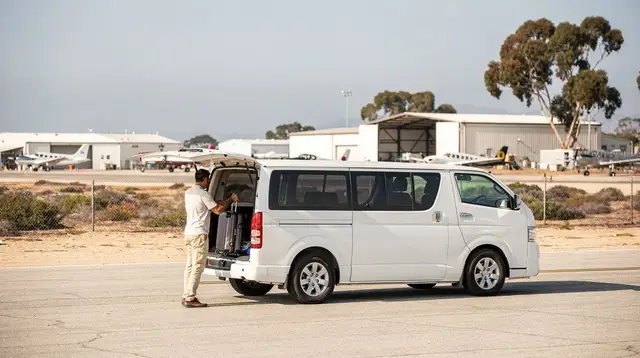
GetYourGuide does not provide a product photo for this activity — the image shows the meeting point, photographed by us.