Why San Diego works as a day trip from Los Angeles
Among the destinations that visitors weigh against a Los Angeles base, San Diego occupies a different category than Las Vegas. Las Vegas sits far enough away that most travelers treat it as an overnight trip, or fly rather than drive. San Diego is different: it sits roughly two hours south of Los Angeles along the coastal freeway system, close enough that a genuine day trip is possible without an overnight stay.
That single fact shapes how this page treats the city — not as a multi-day detour, but as a destination that fits neatly into a single day away from a Los Angeles-based itinerary, alongside options like a day near Palm Springs or a loop through Orange County.
San Diego is still California. It sits close to the Mexican border, a detail that surprises visitors who assume it is simply “further along the same coast” as Los Angeles. The city has its own downtown, its own bay, and its own identity shaped by the US Navy, decades of Mexican and Spanish-era heritage, and a large research and biotech economy — it is not a suburb of Los Angeles or a smaller copy of it.
Climate is one of the clearer differences between the two cities. Los Angeles experiences the coastal marine layer known locally as May Gray and June Gloom, along with occasional Santa Ana wind events in autumn that push temperatures up sharply. San Diego’s weather tends to be somewhat drier and more stable through the year, with less of the dramatic swing between coast and inland valley that defines a Los Angeles day. That stability is part of why a San Diego day trip is a comparatively low-risk plan: conditions rarely force a change of itinerary the way desert heat or coastal fog sometimes do further north.
The core of a San Diego day: USS Midway and Old Town
For a single day trip, this page keeps the focus tight rather than trying to cover everything San Diego offers. Two anchors define a workable day: the USS Midway Museum and Old Town San Diego.
The USS Midway is a decommissioned aircraft carrier permanently docked on the downtown waterfront, now open as a floating museum with flight decks, aircraft, and berthing areas open to visitors. It is one of the largest museum ships in the world, and walking its decks takes real time — visitors regularly spend two hours or more moving through hangar bays, the flight deck, and the bridge. It rewards an unhurried pace rather than a quick pass-through.
Old Town San Diego, a short drive or rideshare from the waterfront, preserves the city’s Spanish and Mexican-era core with restored adobe buildings, plazas, and a concentration of Mexican restaurants and shops. It is walkable, shaded in parts, and works well as a lower-intensity counterpart to the Midway’s scale — a place to slow down, eat, and get a sense of the city’s older layers rather than its naval history.
It is worth being direct about pacing: fitting both the USS Midway and Old Town into a single morning is not realistic. The Midway alone can absorb two to three hours for visitors who want to see it properly, and Old Town deserves at least an hour or two on top of that, plus a meal. A full day that includes both sites, a lunch stop, and the drive down and back from Los Angeles is a reasonable target — but treating it as a “quick morning stop” undersells both places and usually means rushing through one or both.
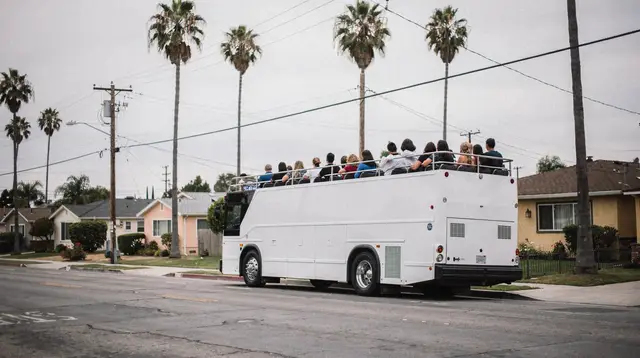
a guided day tour from Los Angeles that combines the USS Midway with Old Town San Diego removes the logistics question entirely: transport, a fixed itinerary, and a guide who paces the day are handled for you, which matters on a route where traffic timing is genuinely unpredictable.
Getting there: the I-5 and why timing matters
The standard route from Los Angeles to San Diego runs down the I-5 freeway along the coast, and the trip is commonly described as “about two hours.” That figure holds up reasonably well in free-flowing traffic, but it is a description of distance and speed under good conditions, not a promise. The I-5 corridor through Orange County and north San Diego County is one of the busier freeway stretches in Southern California, and it backs up predictably on weekday mornings and afternoons, and on weekend days when beach traffic and returning day-trippers overlap.
Practically, that means a trip planned for a Saturday or Sunday, or one that starts or ends during peak commuting hours, should be budgeted with real slack — the same drive that takes two hours at 10am on a Tuesday can stretch well past two and a half hours on a Friday evening. This is not a case where the extra time is a rare exception; it is a normal part of driving this corridor, and travelers who build their day-trip plan around a strict two-hour window in both directions are setting themselves up for a late return or a rushed departure.
For travelers without a car, or those who would rather not drive the corridor themselves, a booked tour absorbs this uncertainty into someone else’s schedule rather than the visitor’s own.
Airports: San Diego has its own gateway
It’s worth noting that San Diego is not only reachable by road from Los Angeles. The city has its own international airport, San Diego International (SAN), located close to downtown — a detail that matters for travelers arriving from elsewhere, or comparing a Los Angeles home base against staying in San Diego directly for part of a trip.
Airport shuttle and transfer services in the region also serve secondary airports rather than routing everyone through LAX, which is a useful thing to know when comparing itineraries that treat Los Angeles as the sole point of entry to Southern California; travelers flying in from outside the region should check which airport actually suits their plans, since defaulting to LAX is not always the most efficient choice.
Extending the day: Temecula and Carlsbad, kept separate
A San Diego day trip pairs naturally with two other destinations south of Los Angeles, and it is worth being precise about how they differ from San Diego itself, since all three sit along the same general corridor and are easy to blur together.
Temecula wine country lies inland, roughly on the way between Los Angeles and San Diego, and its identity is built around vineyards, tasting rooms, and rolling wine-country scenery rather than a coastal city or naval history. It is a distinct destination in its own right, not a suburb of San Diego, and travelers who want a wine-focused day should look there directly rather than expecting to fold it into a Midway-and-Old-Town itinerary.
A tour such as a scenic guided day out through Temecula wine country is built specifically around that inland wine identity, and works better as its own day than as an add-on to a San Diego city day.
Carlsbad, on the coast north of San Diego proper, has a different center of gravity again: it is best known for Legoland California and the adjoining Sea Life Aquarium, making it a strong choice for a family day built around a theme park rather than a history-and-navy day downtown. Options like a one-day admission ticket to Legoland California Resort serve that family-park version of a day out, which is a genuinely different trip from the one this page describes. Families weighing the two should be clear about which day they actually want: a theme park day belongs to Carlsbad, not to San Diego’s historic waterfront.
This page keeps its focus on San Diego’s own core — the bay, the Midway, and Old Town — precisely so it does not duplicate what the Temecula and Carlsbad pages already cover. Visitors piecing together a longer Southern California loop can treat all three as separate, complementary days rather than assuming any one of them substitutes for the others.
Families who want the Carlsbad theme-park day rather than the San Diego history day have a second option worth knowing about: a combined Legoland California and Sea Life Aquarium package, which pairs the theme park with the adjoining aquarium in a single admission rather than requiring two separate stops. Again, this belongs to a Carlsbad day, not a San Diego one — the distinction is worth keeping straight when planning which day goes where.
Coastal towns along the way: Orange County between LA and San Diego
The I-5 corridor between Los Angeles and San Diego does not run through empty freeway the whole way — it passes close to a string of coastal Orange County towns that some travelers choose to break the drive with, or substitute for a full San Diego day if time is tighter than expected. Long Beach, just south of Los Angeles proper, is the first of these, with its own waterfront and port.
Further south, Huntington Beach, Newport Beach, Laguna Beach, and Dana Point sit along the coast in that order, each with a different character — from Huntington Beach’s wide surf beaches to Laguna Beach’s cliffside coves to Dana Point’s harbor and whale-watching departures.
None of these towns are a substitute for San Diego’s own core — they belong to Orange County as its own destination, and this page does not attempt to fold them into a San Diego day. But travelers who find the two-hour drive daunting, or who want to break a longer Southern California loop into smaller pieces, sometimes treat one of these towns as a coastal stop on the way down or back rather than committing to the full San Diego day described here.
Planning resources for a San Diego day
A few practical guides go deeper on pieces of this trip than a single destination page can. For the logistics of actually getting south and back, see the dedicated transfers and transport guide for San Diego from LA. Travelers who want to prioritize the Midway alongside San Diego’s other museums and landmarks can check the museums and landmarks guide, and those tempted to extend the day toward Temecula’s vineyards should look at the San Diego area wine and drinks guide before assuming it fits into the same day as the Midway and Old Town.
Travelers weighing a full week around this route rather than a single day trip may find the five-day Los Angeles and San Diego itinerary more useful, since it spreads both cities’ highlights across enough days to avoid the compressed pacing this page describes for a single-day version.
What a realistic day actually looks like
A day trip built around San Diego benefits from an honest sense of sequence and pace, rather than an attempt to see the entire city:
| Segment | What it involves | Rough time needed |
|---|---|---|
| Drive from Los Angeles | I-5 south, variable with traffic | About 2 hours in light traffic; more at peak times |
| USS Midway Museum | Flight deck, hangar bay, bridge tour | 2-3 hours for an unhurried visit |
| Lunch | Downtown waterfront or Old Town | 45-60 minutes |
| Old Town San Diego | Historic plazas, shops, adobe buildings | 1.5-2 hours |
| Drive back to Los Angeles | I-5 north, worse at evening peak | About 2 hours, more on weekends/evenings |
Laid out this way, the day is full but workable — provided the return drive is not scheduled to start right into evening rush hour. Travelers who want to protect their evening should aim to leave San Diego by mid-afternoon rather than treating the drive back as an afterthought.
Common mistakes to avoid
- Assuming the two-hour drive is fixed. It is a figure for light traffic conditions on the I-5, not a guarantee. Weekend afternoons and weekday commute windows regularly push the drive well past two hours in either direction.
- Trying to fit the USS Midway and Old Town into a single morning. Both sites reward a slower pace; treating them as a quick pass-through undersells the depth of what each offers, especially the Midway’s scale.
- Confusing San Diego with Temecula or Carlsbad. Temecula is inland wine country; Carlsbad is a coastal theme-park town built around Legoland. San Diego itself is the historic, maritime city — the three are separate days, not interchangeable stops.
- Forgetting that San Diego has its own airport. Travelers flying into the region should check whether San Diego International or a nearer secondary airport suits their itinerary better than defaulting to LAX.
- Underestimating San Diego’s independence from Los Angeles. It has its own downtown, its own bay, and sits near the Mexican border — it is not a Los Angeles suburb or an extension of the same metro area.
San Diego day trip: frequently asked questions
Is San Diego close enough to Los Angeles for a day trip?
Yes. San Diego is roughly two hours south of Los Angeles by coastal freeway, which is close enough to drive down, spend a full day, and return the same evening — a genuinely different proposition from a destination like Las Vegas, which sits too far away for a comfortable round trip in one day.
How long does the drive from Los Angeles to San Diego actually take?
Around two hours under light traffic conditions on the I-5, but this is not a fixed figure. Weekday morning and evening commute periods, and weekend afternoons, regularly push the drive noticeably longer, so travelers should build in slack rather than planning around the two-hour estimate as a guarantee.
Can you see the USS Midway and Old Town in one morning?
Not comfortably. The USS Midway alone can take two to three hours to see properly, given its scale, and Old Town deserves at least an hour or two on top of that. A realistic plan treats both sites as a full day, not a single morning.
Is San Diego part of Los Angeles?
No. San Diego is a separate, independent city with its own downtown, bay, and metropolitan area, located near the US-Mexico border. It is not a suburb or district of Los Angeles, despite sitting along the same general Southern California coastline.
Is the weather in San Diego different from Los Angeles?
Generally yes. San Diego’s climate tends to be somewhat drier and more consistent through the year than Los Angeles, which experiences more pronounced coastal fog in late spring and early summer, and occasional sharp heat spikes from Santa Ana wind events in autumn.
Should I combine San Diego with Temecula or Carlsbad on the same day?
It is possible but not recommended if the goal is to see San Diego’s core properly. Temecula is inland wine country and Carlsbad is built around Legoland and the coast further north — each is really its own day. Stacking one of them onto a San Diego day usually means rushing all of them.
Does San Diego have its own airport?
Yes. San Diego International Airport (SAN) sits close to downtown, and regional shuttle and transfer services also serve other secondary airports in the area — travelers arriving from outside Southern California should check whether flying directly into San Diego suits their itinerary better than routing through LAX. For travelers landing in San Diego and heading north to Carlsbad rather than staying downtown, a direct airport shuttle service to Carlsbad avoids the need to rent a car for that leg.
Is a guided tour worth it compared to driving myself?
For a day trip with this much freeway time and two dense sites to cover, a guided tour removes the uncertainty around traffic timing and lets a driver focus on the destinations rather than the road. Self-driving offers more flexibility on pacing, but only if the traffic risk on the I-5 is accepted as part of the plan. The choice mirrors whether to rent a car in Los Angeles more generally, and travelers who lean toward rideshare over a rental for their LA stay should read the broader rental car versus rideshare comparison before deciding how to handle the San Diego leg specifically.
How does a San Diego day trip compare to visiting San Diego on its own terms?
They are different questions. This page treats San Diego as a day trip built around a Los Angeles base; the separate Los Angeles versus San Diego comparison looks at the broader question of which city suits a traveler better as a home base for a longer Southern California trip, and is worth reading before assuming a day trip is the right amount of San Diego for a given visit.
What about driving conditions specific to this route?
The I-5 south of Los Angeles shares the same general driving and parking considerations covered in the Los Angeles driving and parking guide, though the San Diego leg adds its own traffic patterns around Orange County. Travelers who are also weighing a Las Vegas trip from the same base can compare the two routes in Las Vegas from Los Angeles: car or plane — the calculus is different from San Diego’s, since Las Vegas sits too far for a comfortable same-day round trip.