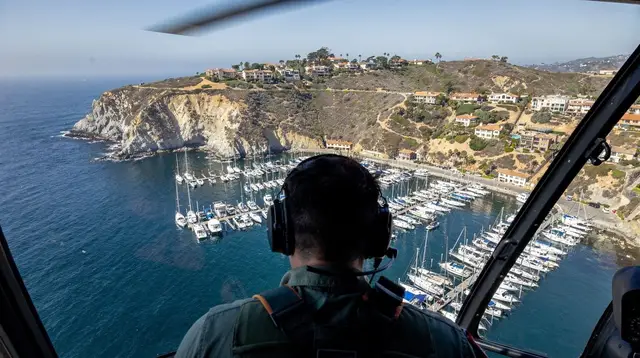
Helicopter Flights to Catalina Island and Avalon
What is a helicopter flight to Catalina Island actually like?
It is a short crossing from a mainland heliport, typically Long Beach or San Pedro, to Avalon on Catalina Island, usually under 20 minutes each way. It is faster than the ferry but not immune to weather, and seats are limited, so booking ahead is essential.
Two ways to cross, one island at the end
Catalina Island sits off the southern California coast, roughly opposite Orange County, and there is no bridge or causeway to it. Every visitor arrives the same fundamental way: either by boat across open water, or by air across the same stretch of water in a fraction of the time. This page is specifically about the second option seen from the island side of the crossing, meaning flights that either land at or depart from Avalon, Catalina’s small harbor town.
If the plan is instead a scenic helicopter flight that departs from and returns to the mainland without landing on the island, that is a different product, and the pages for Santa Monica, Newport Beach and Dana Point helicopter flights cover that version.
The distinction matters because it changes what the flight is for. A mainland scenic flight sells a view. A Catalina Island helicopter flight sells a crossing: it gets a traveler from the Los Angeles or Orange County coastline to an island that would otherwise take roughly an hour by boat, and it does so in something closer to 15 to 20 minutes in the air. That time saving is the entire point of the product, and it is also exactly why weather and scheduling constraints matter more here than on a purely scenic ride.
What the crossing actually involves
A typical helicopter crossing to Catalina Island departs from a mainland heliport in the Long Beach or San Pedro area and lands at Avalon’s heliport, a short distance from the town center. The flight path crosses open ocean for most of its length, which is a meaningfully different flying environment from a flight that stays over land or close to the coastline the whole way. Marine conditions, including the low cloud and fog known locally as May Gray and June Gloom, and coastal wind, are the main reasons a scheduled flight can be delayed or cancelled. No operator can honestly promise a flight that runs in any weather; a same-day cancellation or rebooking is a normal possibility, not a sign that something has gone wrong.
Seats on these flights are limited, aircraft are small, and schedules run on a limited number of departures per day rather than a continuous shuttle. Booking in advance is not optional in practice: walking up on the day and expecting an open seat, especially in summer, is a poor plan. For a flight timed around Avalon, an option such as the Avalon aerial helicopter crossing is built specifically around that island-side arrival and departure, rather than a mainland loop.
It is worth being precise about what the time saving does and does not include. The flight itself is genuinely much shorter than the boat, but the total time from leaving a mainland hotel to standing in Avalon also includes getting to the heliport, checking in, any weight or luggage limits on the aircraft, and the short transfer into town on the island side. Comparing “20 minutes in the air” against “about an hour on the boat” understates the boat’s simplicity and overstates how much total time the helicopter saves door to door. Both are real, useful ways to reach the island; neither is instant.
Choosing a mainland heliport
Not every Catalina Island helicopter flight departs from the same mainland point, and the choice affects how the rest of the day fits together. Long Beach and San Pedro are the two main departure areas covered by most operators serving Avalon, and each sits at a different distance from the rest of a Los Angeles or Orange County itinerary.
A traveler staying near the coast north of the airport, or wanting to combine the crossing with time in Santa Monica, is better served by an option built around that specific routing, such as the helicopter transfer between Catalina Island and Santa Monica, which treats the flight as a direct link between those two points rather than a generic Long Beach departure.
Getting to whichever heliport is used still takes planning: see the general Los Angeles transfers and transport guide and the wider Los Angeles transport overview for how ride options and travel times work across the region, since a missed connection on the mainland side can matter as much as the flight itself.
Avalon is a small town, not a city
One detail that surprises first-time visitors is the sheer scale difference between Avalon and the mainland they just left. Los Angeles and Orange County are sprawling, car-dependent, multi-hour-drive kinds of places. Avalon is a compact harbor town that most visitors can walk end to end. Landing by helicopter drops a visitor close to the middle of that walkable core, which is a genuine practical advantage over some boat terminals that sit a short shuttle ride from downtown. There is no need to rent a car on the island for a short stay, and most of Avalon’s shops, restaurants and waterfront are within easy walking distance of both the heliport and the harbor.
That compactness also shapes what a typical Catalina day looks like once travelers are on the ground. Popular options include the inland adventure tour into Catalina’s backcountry for visitors who want to get beyond the harbor, or the scenic tour up to Mt. Ada overlooking Avalon for a view back down over the town and the crossing just completed. Both are the kind of half-day activity that fits comfortably around a helicopter’s fixed departure and return times, since the flight itself is a short slice of the day rather than an all-day commitment the way the full round-trip boat schedule can be.
Climate on the island, briefly
Catalina follows the same broad Southern California pattern as the mainland coast: dry, warm summers and a cooler, wetter winter, with most of the modest annual rainfall falling roughly between November and March. Because the island sits in open water rather than against the mainland coastline, it is also exposed to the same marine layer effects that produce overcast mornings in late spring and early summer, sometimes clearing to sun by afternoon. Practically, this means a summer visit gives the most consistent flying weather, while a winter or early-summer trip carries a higher chance that a scheduled flight shifts by an hour or more, or moves to a different day.
A helicopter crossing that can slip by an hour or move to another day in winter or early summer should not sit on the last day of your trip. Leave a spare day between your Catalina plans and your flight home, and check the change rules on the fare before paying, because weather is the likeliest reason to rebook. You can compare flights to Los Angeles on Aviasales with that buffer in mind.
Helicopter or boat: what actually differs
The honest comparison is not simply “faster versus slower.” Each mode of crossing has a different profile, and the right one depends on what a traveler actually wants from the journey itself, not just the destination.
| Helicopter crossing | Boat crossing | |
|---|---|---|
| Typical crossing time | Roughly 15-20 minutes | Roughly 60 minutes |
| Weather sensitivity | Sensitive to marine fog, wind and low visibility | Sensitive mainly to rough seas and storm conditions |
| Booking lead time | Limited seats; advance booking essential | More capacity; advance booking still recommended in peak season |
| Luggage | Typically limited by weight | Generally more flexible |
| Character of the crossing | Fast, functional, scenic from above | Slower, sea-level, can include wildlife sightings |
| Arrival point on Catalina | Avalon heliport, short walk to town | Avalon harbor terminal, short walk to town |
Travelers who want the crossing itself to be part of the experience, rather than a hurdle to get past, often lean toward a boat option, particularly one built around scenery or wildlife rather than pure transport. The San Pedro to Catalina Island boat crossing and the dolphin and sea lion boat tour on the Catalina crossing both turn the hour on the water into the point of the outing rather than a delay before it. Neither should be assumed interchangeable with the helicopter in terms of total time; they are genuinely different products serving different priorities.
Common mistakes with Catalina Island helicopter flights
A few assumptions catch visitors out repeatedly when planning this specific leg of a Southern California trip.
- Assuming an all-weather flight. Marine fog and wind are routine along this stretch of coast, and a helicopter crossing over open water is more exposed to them than a flight that stays over land. Build a buffer into any onward plans, such as a flight home the same evening, rather than scheduling back-to-back with no slack.
- Assuming the flight time equals the total time saved. The 15 to 20 minutes in the air is real, but heliport check-in, luggage limits and the transfer at each end add time that a straight flight-time comparison against the one-hour boat leaves out.
- Confusing this with a Los Angeles scenic helicopter tour. A flight over the Hollywood Sign or the LA skyline that returns to where it started is a different product with different considerations from a point-to-point crossing to an island. The two should not be booked expecting the same thing.
- Expecting Avalon to feel like a mainland destination. Avalon is a small island town, not a satellite of Los Angeles or Orange County. Visitors expecting big-city scale or a car-first layout are usually surprised, in a good way, by how walkable and small the town actually is.
- Booking on arrival day in peak season. Summer weekends sell out helicopter seats well in advance. Waiting until the day of travel to book a flight to or from Catalina is a common and avoidable source of disappointment.
- Treating the boat as strictly the “slow” option with nothing to offer. For travelers who enjoy the crossing itself, including wildlife along the way, the boat is not simply a worse version of the helicopter; it is a different kind of trip.
Planning the rest of a Catalina day around a helicopter crossing
Because the flight itself takes up so little of the day, most visitors build a Catalina Island itinerary around ground activities on the island and treat the crossing as bookends. Given Avalon’s compact scale, walking tours and short excursions from town are realistic even for a day trip. For a broader sense of how a Catalina day trip fits into a wider Los Angeles or Orange County itinerary, see Catalina Island as a day trip from Los Angeles and the general overview of things to do on Catalina Island.
Travelers weighing whether to fly at all should also look at the broader picture of Catalina’s boat cruises, water sports, hiking and nature options, adventure sports and private tours, since the choice of crossing is really just the first decision in a longer list.
For visitors comparing this island entirely against a mainland-based day, the Catalina Island sightseeing tours and games and shows guides round out what a full day or overnight on the island can look like, alongside the more atmospheric ghost and true crime tours that some visitors add to an Avalon evening.
For context on how this fits against the mainland side of the same route, the Santa Monica, Newport Beach and Dana Point helicopter pages describe the same crossing from the departure point rather than the arrival point, and the wider Orange County and Los Angeles destination pages give a sense of just how different the mainland’s scale is from the small island town waiting at the other end of a 20-minute flight.
Filling the ground time in Avalon
Because a helicopter crossing leaves so much of a Catalina day still ahead, it is worth deciding in advance what that ground time on the island will actually be spent on, rather than improvising it after landing. Avalon’s walkable core means a visitor can go straight from the heliport into town on foot, but many of the island’s best-known activities sit slightly outside that core and are easier to reach with a short guided ride than by walking in the heat.
A private golf cart tour of Avalon and its hillside overlooks is a common way to cover more ground than walking allows without needing a car, and it pairs naturally with a short flight that already leaves the middle of the day free. For visitors who want to get on the water rather than look at it from a hillside, a parasailing flight over Avalon’s harbor is another way to see the same coastline from the air, this time from just offshore rather than from the mainland crossing.
Booking these island-side activities around a fixed helicopter departure works best when the flight times are locked in first. Since weather can still push a departure by an hour or more even after booking, building a loose rather than back-to-back schedule around any single ground activity avoids the kind of cascading delay that a tight itinerary cannot absorb.
Getting the timing right
Because both weather and seat availability can shift a departure, the most reliable approach is to book the crossing first, before committing to fixed onward plans such as a same-day flight home from Los Angeles International Airport or a tight hotel checkout. Travelers heading onward to Newport Beach, Long Beach or back into central Los Angeles after an Avalon flight should treat the return crossing time as an estimate that can move, not a fixed slot to plan tightly around.
Helicopter Flights
Verified deep-linked GetYourGuide tours. Book through these links and we earn a small commission at no cost to you.
GetYourGuide does not provide a product photo for this activity — the image shows the meeting point, photographed by us.