Professional Photo Sessions in Los Angeles's Iconic Districts
What does a professional photo session in Los Angeles actually cover?
A single session with a local photographer typically covers two to four locations within one district cluster, such as Hollywood and Griffith Observatory, or Downtown and West Hollywood, because driving between LA's spread-out neighborhoods eats into shoot time. The Hollywood Sign itself is photographed from a distance at viewpoints like Griffith Observatory or Lake Hollywood Park, not up close. Edited images are usually delivered some days after the session, not on the spot.
A different backdrop than the coast
Photo sessions built around Santa Monica or Santa Barbara lean on piers, palm-lined boardwalks and small-town main streets. A session in the Los Angeles core works with a different visual language entirely: the Hollywood Walk of Fame, the skyline of Downtown LA, the observatory perched above the city, the manicured streets of Beverly Hills, and the low-slung, palm-dotted blocks of West Hollywood. These are urban and emblematic settings rather than coastal or provincial ones, and they photograph very differently from a beach town — more architecture and skyline, less sand and horizon.
That difference is also practical. A coastal session can often stay within walking distance of a single strip of shoreline. A session in central LA almost always means moving between separate, self-contained districts, each with its own character, parking situation and best light. Understanding how those districts relate to each other — and how far apart they really are — matters more here than in almost any other part of a Los Angeles trip.
Which districts a single session usually covers
Most professional photo sessions in this part of the city are built around one of a handful of natural pairings, chosen because the locations sit reasonably close together and share a similar mood:
- Hollywood and Griffith Observatory — the Walk of Fame or Hollywood Boulevard storefronts paired with the hilltop views and Art Deco architecture of the observatory.
- Downtown LA on its own — Grand Central Market, the Arts District murals, Union Station’s tiled halls and the modern skyline around Bunker Hill.
- Beverly Hills and West Hollywood — Rodeo Drive’s palm-lined blocks and the Sunset Strip’s retro signage, both associated with a glossier, more polished LA look.
- Pasadena as a separate outing — Craftsman-era streets and the Colorado Street Bridge, distinct enough in style that it rarely gets folded into a Hollywood-based booking.
A session such as the guided city photo session covering Hollywood and Beverly Hills is built around exactly this kind of pairing rather than trying to stretch across the whole basin. That is a deliberate constraint, not a limitation of the photographer: it reflects how the city itself is laid out.
The Hollywood Sign problem
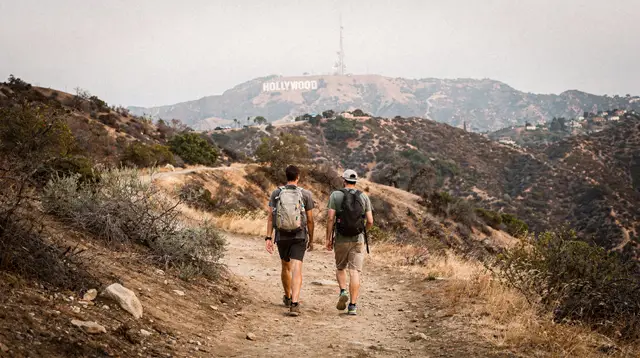
The single most common misunderstanding about photo sessions in this part of Los Angeles concerns the Hollywood Sign. There is no path that leads up to it, no viewing platform at its base, and no way for a photographer to pose a client directly in front of it. The letters sit on restricted hillside land, fenced and monitored, and the nearest public trails only bring hikers to a distance well above and behind the sign — not a flattering angle, and not one most people picture when they imagine a “Hollywood Sign photo.”
What actually works is framing the sign from a distance, using it as a backdrop rather than a close subject. Griffith Observatory’s terraces are the best-known spot for this: the sign sits on a nearby ridge, visible over the observatory’s own domes, with the city spreading out below. Lake Hollywood Park, on the west side of the reservoir, offers a similar long-range framing from ground level rather than a hilltop. A short guided outing such as the express walking route to a Hollywood Sign viewpoint is built specifically around reaching one of these vantage points efficiently, rather than promising anything closer.
Any product or photographer that implies a close-up shoot at the sign itself is describing something that does not exist as a public option. It is worth setting that expectation before booking, not after arriving.
Planning around LA’s driving distances
The four or five districts that make up a typical central-LA photo itinerary — Hollywood, Downtown, Griffith Park, Beverly Hills, West Hollywood, Pasadena — often look close together on a map of the city. In practice, each pair is commonly a 30- to 60-minute drive apart, and that range swings wider still during weekday rush hour, when the same route can take close to double the off-peak time.
This is the main reason sessions cluster around two or three locations rather than trying to hit everything in one booking. A photographer who agrees to shoot in Hollywood, Downtown and Beverly Hills in a single two-hour window is either planning a very rushed session or quietly planning to drop a location once the traffic reality sets in. Sessions that promise coverage of the entire list of central districts without factoring in real drive time should be treated with some skepticism — it is not a matter of the photographer’s skill, it is the geography of the city.
A useful way to plan is to pick one cluster per session:
| Cluster | Typical locations | Rough driving spread |
|---|---|---|
| Hollywood + Griffith | Walk of Fame, Griffith Observatory, sign viewpoint | 15-25 minutes between stops |
| Downtown only | Grand Central Market, Arts District, Union Station | Often walkable between stops |
| Beverly Hills + West Hollywood | Rodeo Drive, Sunset Strip | 10-20 minutes between stops |
| Pasadena | Old Pasadena, Colorado Street Bridge | Best kept as its own outing |
Crossing between clusters — say, Downtown to Beverly Hills — typically adds 30 to 45 minutes each way outside rush hour, and meaningfully more during it.
Downtown LA as a backdrop
Downtown LA offers a different visual register from Hollywood: glass towers, restored early-20th-century facades, the tiled ceilings of Union Station and the mural-covered walls of the Arts District. It is also one of the few central clusters where a session can move between stops without a car, since several of the standout spots sit within walking distance of each other.
That makes it a comparatively efficient half-day option compared with clusters that require driving between every stop, and it pairs naturally with a broader look at the city on something like the guided city highlights outing, which takes in Downtown alongside other central landmarks.
Griffith Observatory and Griffith Park
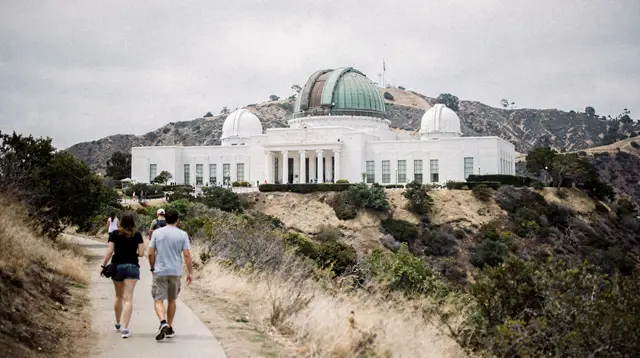
Beyond its role as a Hollywood Sign viewpoint, Griffith Observatory is a strong location in its own right, with Art Deco domes, sweeping terraces and views over the basin toward the ocean on a clear day. The building and grounds themselves cost nothing to visit, which makes it an easy add-on to a session, but the practical constraint is parking: the lot is limited and fills early, especially around sunset — the time of day that also happens to produce the best light for photographs. Sessions built around a sunset shoot here generally need to arrive with a wide buffer, not show up at the target hour and hope for a spot.
Beverly Hills, West Hollywood and the gloss factor
Beverly Hills and West Hollywood sit next to each other and share a more polished, curated look than Hollywood proper — palm-lined streets, boutique storefronts on Rodeo Drive, and the retro neon of the Sunset Strip.
A session paired between the two can move on foot or with a short drive along a handful of connecting blocks, making it one of the more efficient central-LA pairings once a client is already based in that part of the city. An open-air overview like the Hollywood-focused walking route or a wider city tour can help scout which specific blocks suit a shoot before committing a full session to them.
Pasadena: usually its own trip
Pasadena has a distinct architectural identity — Craftsman bungalows, the Colorado Street Bridge, tree-lined streets that read very differently from anywhere closer to Hollywood — but it sits far enough northeast of the central cluster that folding it into a Hollywood-or-Downtown session usually means giving up a location elsewhere to make the drive work. It photographs better treated as its own half-day outing, or combined with a Downtown session for clients staying on that side of the city, than squeezed onto the end of a Hollywood-and-Griffith booking.
What to expect from booking to delivery
Sessions in this part of Los Angeles are generally booked in advance, timed around a preferred cluster of locations and a target time of day — sunrise for Downtown’s quiet streets, late afternoon for Griffith Observatory’s light, or midday for Beverly Hills’ brighter storefronts. On the day itself, the photographer usually leads the group between the agreed stops, working around parking and foot traffic at each one.
Delivery of the final images comes afterward. Photographers typically shoot far more frames than they deliver, then select and retouch a smaller set before sending the finished gallery — a process that takes some days rather than happening on the spot. Anyone booking a session close to the end of a trip should factor that turnaround into their plans rather than expecting to walk away with finished photos the same afternoon.
For visitors who want a broader look at several of these districts before committing to a specific shoot location, an open-top overview such as a general city tour of Los Angeles or the more extensive grand tour covering the city’s main landmarks can help narrow down which cluster of neighborhoods actually matches the look a client has in mind, before booking a dedicated photographer.
Timing a session around the rest of a visit
Because central LA sessions depend so heavily on light and parking, they tend to sit best at the start or end of a day rather than in the middle. A one-day Hollywood and Griffith itinerary built around sunrise or late-afternoon light leaves the middle of the day free for museums, food or the drive to a second cluster. Visitors weighing where to stay relative to these districts may also find it useful to check general guidance on driving and parking in Los Angeles, since a session’s schedule can slip quickly once rush-hour traffic is added to the mix.
For a deeper look at the individual locations themselves, see the guides to Hollywood Boulevard, Los Angeles museums and landmarks, and the separate world of studio tours, which involve working film and TV lots rather than public photo locations. For the sign specifically, the dedicated piece on how to see the Hollywood Sign covers the viewpoints in more detail, and the Griffith Observatory activity page lists the other things worth doing on the same visit.
FAQ: Planning a Photo Session in Central Los Angeles
How many locations can one photo session realistically cover in a day?
Most sessions stick to two to four locations that sit within the same general area, for example Hollywood plus Griffith Observatory, or Downtown LA plus the Arts District. Trying to add Beverly Hills or Pasadena to the same booking usually means sacrificing shoot time to driving, since districts that look close on a map are commonly 30 to 60 minutes apart by car depending on traffic.
Can I get photographed right next to the Hollywood Sign?
No. There is no public access to the base of the Hollywood Sign, and no session can walk a client up to it. Photographers work from marked viewpoints such as Griffith Observatory, Lake Hollywood Park or spots around the Hollywood district itself, framing the sign at a distance rather than as a close-up backdrop.
How far apart are Hollywood, Downtown LA and Beverly Hills?
Each pair is a drive of roughly 20 to 45 minutes in free-flowing traffic, and comfortably longer during weekday rush hour. None of the three is walkable from another, so a session that includes all three needs a generous time block built around driving, not just shooting.
How long does it take to receive the edited photos after the session?
Photographers generally deliver a retouched gallery after the shoot rather than handing over final images the same day, since selection and editing happen afterward. The exact turnaround varies by photographer and package, so it is worth confirming timing directly when booking rather than assuming next-day delivery.
Is Griffith Observatory a good location for a photo session?
Yes, both for its own architecture and grounds and as the best publicly accessible vantage point for framing the Hollywood Sign at a distance. The trade-off is parking, which is limited and fills quickly around sunset and on weekends, so sessions there are usually timed carefully rather than left open-ended.
Do I need a permit for a photo session in these Los Angeles districts?
Casual sessions with a handheld camera and a small group are generally fine in public areas, but larger productions, tripods and lighting setups, or shoots on private property such as studio backlots or hotel grounds, can require permits or prior arrangement. A local photographer booked through a tour or session product typically already accounts for this.
What should I wear or bring to a photo session in Los Angeles?
Layers work well, since coastal-influenced mornings in nearby areas can be cool while inland spots like Downtown or Pasadena warm up faster later in the day. Comfortable shoes matter more than the wardrobe itself, since even a two-location session usually involves some walking around each stop, plus getting in and out of the car repeatedly.
Is Pasadena worth adding to a Hollywood-area session?
Pasadena has its own distinct architecture and streetscape, but it sits far enough from Hollywood and Downtown that combining it with either in one session usually means dropping a location elsewhere. It works better as its own session or paired with a Downtown-focused shoot than tacked onto a Hollywood-and-Griffith itinerary.
Photo Sessions
Verified deep-linked GetYourGuide tours. Book through these links and we earn a small commission at no cost to you.
GetYourGuide does not provide a product photo for this activity — the image shows the meeting point, photographed by us.