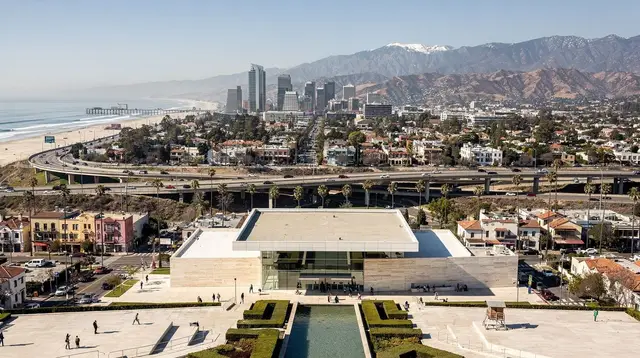
Museums and Landmarks Near Santa Monica: A Coastal Guide
What museums and landmarks are actually near Santa Monica?
Santa Monica itself has a handful of sights, led by the Museum of Illusions on the Third Street Promenade, plus the pier and its small aquarium. Bigger institutions like the Getty Center, LACMA and the Aquarium of the Pacific sit in nearby coastal or inland cities, generally 20 to 60 minutes away by car.
A coastal take on museums and landmarks
Los Angeles has two very different ways to organize a museums-and-landmarks day. One version stays inland, moving between Downtown LA, Hollywood and Pasadena, where the big encyclopedic museums and historic studio-era landmarks cluster together. The other stays on the coast, threading together Santa Monica, Venice, Malibu, Long Beach and the South Bay, where the sights are smaller, more scattered, and shaped by the beach itself. This guide covers the second version, anchored in Santa Monica.
That distinction matters because visitors often assume “Los Angeles museums” means one contiguous itinerary. It doesn’t. If your base is a beach city and you want a landmarks day without a long inland drive, this guide sticks to what is genuinely reachable along the coastal corridor. For the inland cluster - the Getty, LACMA, The Broad, Griffith Observatory and the historic core of Downtown - see the companion guide to Los Angeles museums and landmarks, which treats that inland grouping as its own trip.
Santa Monica itself is compact enough to explore without a car for an afternoon, which is unusual for this region. Most of what follows either sits inside Santa Monica proper or requires a short, clearly-flagged drive south or north along the coast.
What’s actually in Santa Monica
Santa Monica’s own landmark roster is short but solid. The Museum of Illusions near the Third Street Promenade is the closest thing the area has to a dedicated indoor museum experience - a compact, photo-friendly attraction built around optical illusion rooms, popular with families and less physically demanding than a beach day.
The Santa Monica Pier is the area’s best-known landmark, combining a working amusement pier (Pacific Park, with its small Ferris wheel and midway games) with a modest aquarium tucked underneath the pier deck. That aquarium is a hands-on, education-focused facility aimed mainly at kids, and it should not be confused with the much larger Aquarium of the Pacific in Long Beach, covered below.
Beyond the pier, Santa Monica’s landmark value is mostly about the setting itself: the beach, the promenade, and the palm-lined bluffs of Palisades Park overlooking the water. For a broader look at what to actually do here beyond sightseeing, see things to do in Santa Monica.
Venice: canals and boardwalk culture
A short hop south, Venice Beach offers a different kind of landmark: the Venice Canals, a quiet residential network of walkable waterways built in the early 1900s in a nod to the Italian city of the same name, plus the boardwalk itself with its street performers, muscle beach and skate park. Neither the canals nor the boardwalk is a formal museum, but both function as open-air landmarks that pair naturally with a Santa Monica day, since the two areas connect along the beach path. A guided pedal along that stretch, such as a Santa Monica to Venice Beach bike tour, is a common way to cover both without driving.
For visitors who would rather have Venice narrated than self-guided, a walking tour such as a guided walk through Venice’s bohemian side covers the canals, the boardwalk and Muscle Beach with some context attached, which helps first-time visitors sort out what is actually historic from what is just beach-town color.
From the water, a boat cruise running past Venice toward the Malibu coastline offers a different angle on the same shoreline, useful for visitors who want to see the coast without walking it. Either option pairs naturally with the Santa Monica walking tours style of itinerary if you are building a single car-free day around the two areas.
Active ways to cover Santa Monica and Venice
Not every landmark day has to be on foot. A segway tour linking Santa Monica and Venice covers more ground than walking in the same window of time, while a private bike tour along the same route suits visitors who would rather set their own pace than join a group.
For something more casual, a skateboarding lesson on the Venice boardwalk leans into the area’s beach-culture reputation rather than its landmark status, but it is a genuinely popular way to spend an hour between sightseeing stops. All of these operate along the same flat coastal path described above, so none of them requires backtracking or a car partway through the day. See Santa Monica bike and scooter tours for more options along this stretch of coast.
Malibu: the Getty Villa
North along the Pacific Coast Highway, Malibu holds one genuine museum landmark: the Getty Villa, a separate site from the hillside Getty Center, built around a collection of Greek, Roman and Etruscan antiquities inside a recreated ancient Roman country house. It requires a timed-entry reservation booked in advance and charges for parking, though general admission itself is free. The drive from Santa Monica runs roughly 20 to 40 minutes up the coast depending on traffic on the Pacific Coast Highway, which can back up significantly on weekends.
Long Beach: the Aquarium of the Pacific and the Queen Mary
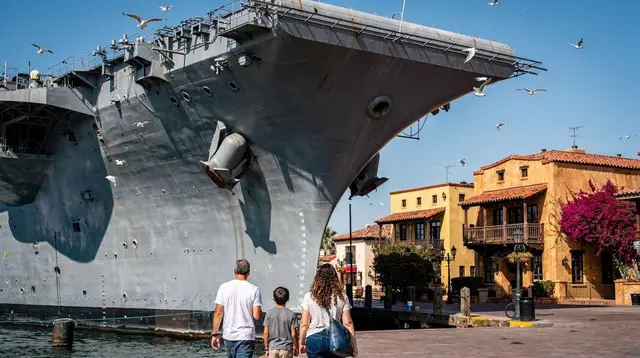
This is the point where itineraries most often go wrong: the Aquarium of the Pacific, one of the region’s most-visited attractions, sits in Long Beach, a separate coastal city roughly 30 to 45 minutes south of Santa Monica by car - not in Santa Monica itself, and not within walking distance of the pier. Long Beach also holds the Queen Mary, a retired ocean liner permanently docked as a hotel and historic attraction, plus the working Port of LA/San Pedro waterfront nearby.
Treat a Long Beach add-on as a deliberate half-day extension rather than an assumed stop on a Santa Monica walk. If the Aquarium of the Pacific is a priority, it is worth building a separate half-day around it rather than squeezing it between beach stops. For a different perspective on the same waterfront, options range from a guided jet ski tour along the Long Beach coastline to a helicopter tour over the Long Beach coast, both of which work better as an add-on to the half-day than as a replacement for the Aquarium and Queen Mary stops themselves.
South Bay: smaller landmarks, same coastal thread
South of Venice and Long Beach, the South Bay cities - Manhattan Beach, Hermosa Beach and Redondo Beach - hold smaller, mostly pier- and beach-focused landmarks rather than formal museums. They fit the same “beach town” character as Santa Monica and Venice but sit further down the coast, generally 30 to 50 minutes from Santa Monica depending on the specific stop. Manhattan Beach in particular is easy to combine with a bike ride, and a dedicated Manhattan Beach bike and scooter tour covers its pier and strand without needing a car once you are there.
The inland extension: framed honestly
For visitors who do want to combine a beach-city day with the inland heavyweights - the Getty Center, LACMA, The Broad, the Natural History Museum or Griffith Observatory - that is a real option, but it should be understood as an extension of a Santa Monica base, not as part of Santa Monica’s own landmark roster.
The Getty Center, despite its coastal-sounding hillside setting above Brentwood, is a 15 to 25 minute drive from Santa Monica, while Downtown LA’s museum cluster and Griffith Observatory run closer to 30 to 60 minutes depending on traffic and time of day. Both are covered in full in the companion guide to Los Angeles museums and landmarks, which treats the inland core as its own dedicated day rather than a bolt-on to a beach itinerary.
Getting between these places
Santa Monica has a genuine advantage here: it is served by the Metro E Line, which runs light rail directly between Santa Monica and Downtown LA. This sets it apart from most of the wider Los Angeles region, where a rental car remains the practical default for reaching attractions. Even so, the E Line does not reach Venice, Malibu, Long Beach or the South Bay, so a car, rideshare or bus remains necessary for most of the itinerary described above.
| Route | Approx. drive time | Notes |
|---|---|---|
| Santa Monica to Venice Beach | 10-15 min | Also walkable/bikeable along the beach path |
| Santa Monica to Malibu (Getty Villa) | 20-40 min | Via Pacific Coast Highway; weekend traffic adds time |
| Santa Monica to Long Beach (Aquarium of the Pacific) | 30-45 min | Treat as a separate half-day, not an add-on |
| Santa Monica to South Bay | 30-50 min | Varies by which South Bay city |
| Santa Monica to Downtown LA / Hollywood museums | 30-60 min | Metro E Line reaches Downtown; no direct transit to Hollywood museums |
| Santa Monica to the Getty Center | 15-25 min | Separate site from the Getty Villa |
Always check current traffic before committing to a same-day combination of coastal and inland stops - the same route can easily take twice as long during rush hour.
A realistic day plan
A single day built around Santa Monica’s own landmarks works well: morning at the Museum of Illusions, a walk or bike ride down to Venice for the canals and boardwalk, then back to the pier for the afternoon. Adding Malibu’s Getty Villa is feasible with an early start and a timed-entry reservation already booked. Adding Long Beach’s Aquarium of the Pacific in the same day is possible but tight, and most visitors are better served giving it its own half-day, paired perhaps with the Queen Mary.
For families balancing beach time with sightseeing, a lower-key alternative is a picnic set-up right on the Santa Monica beach, which keeps the pace relaxed between landmark stops.
Those wanting to stay active along the coast rather than indoors might prefer a guided bike tour linking Santa Monica and Venice, or simply a day pass at a Santa Monica pool club as a landmark-free breather between stops. For a version of this plan already mapped out hour by hour, see the one-day Santa Monica and Venice itinerary.
Where this fits in a longer trip
If museums and landmarks are one piece of a broader coastal stay, see the three-day LA beaches itinerary for a fuller pacing model, or the two-day first-time Los Angeles itinerary if you’re splitting time between the coast and inland sights. For a direct comparison of the two beach neighborhoods most often confused with each other, see Santa Monica vs Venice Beach. And for the broader question of how much car-free travel is realistic here, does the LA Metro cover enough of the city is worth reading before assuming the E Line will get you everywhere on this list.
Practical notes before you go
None of the sights above are covered by a single combined ticket - the Museum of Illusions, the Getty Villa, and the Aquarium of the Pacific are independently operated and separately ticketed, and some, like the Getty Villa, require advance timed-entry booking rather than walk-up admission. Parking is a real cost at nearly every stop; expect to pay for it even where the museum itself is free to enter, as at the Getty properties. Prices shown at the door or online exclude California sales tax, and no tip is expected at museum ticket counters, though it is customary at any sit-down food service you visit along the way.
Frequently asked questions about Santa Monica museums and landmarks
Is the Museum of Illusions the same as the Aquarium of the Pacific?
No. The Museum of Illusions is a small, ticketed attraction in Santa Monica near the Third Street Promenade. The Aquarium of the Pacific is a much larger marine life institution located in Long Beach, roughly 30 to 45 minutes south by car, not in Santa Monica.
Can I walk from Santa Monica to the museums in Downtown LA or Hollywood?
No. Santa Monica sits on the coast and Downtown LA and Hollywood are well inland. There is no walking route between them; expect a drive, rideshare or Metro E Line trip of roughly 30 to 60 minutes depending on traffic and the specific destination.
Does the Metro reach Santa Monica?
Yes. The Metro E Line (formerly the Expo Line) runs light rail directly into Santa Monica, connecting to Downtown LA. This makes Santa Monica one of the easier coastal areas to reach without a car, unlike most of the wider Los Angeles region.
Is there one ticket that covers all the museums mentioned here?
No single combined ticket covers the Museum of Illusions, the Getty Center, LACMA and the Aquarium of the Pacific together. Each is a separate institution with its own admission, and some, like the Getty Center, are free to enter but charge for parking.
Is the Getty Center in Santa Monica?
No. The Getty Center sits in the hills above Brentwood, west LA, a separate area from Santa Monica reached by a roughly 15 to 25 minute drive depending on traffic, with its own paid parking and a free tram to the museum buildings.
What is there to see right on the Santa Monica Pier?
The pier itself has an amusement park (Pacific Park) with a small Ferris wheel and rides, plus a modest aquarium underneath, the Santa Monica Pier Aquarium. It is a much smaller operation than the Aquarium of the Pacific in Long Beach.
Are Venice and Malibu landmarks part of Santa Monica?
No. Venice Beach and Malibu are distinct areas along the same stretch of coast, each with their own landmarks, such as the Venice Canals and the Getty Villa in Malibu. They are grouped here because they share the same beach-city character and are reachable along the same coastal corridor.
Museums and Landmarks
Verified deep-linked GetYourGuide tours. Book through these links and we earn a small commission at no cost to you.
GetYourGuide does not provide a product photo for this activity — the image shows the meeting point, photographed by us.